
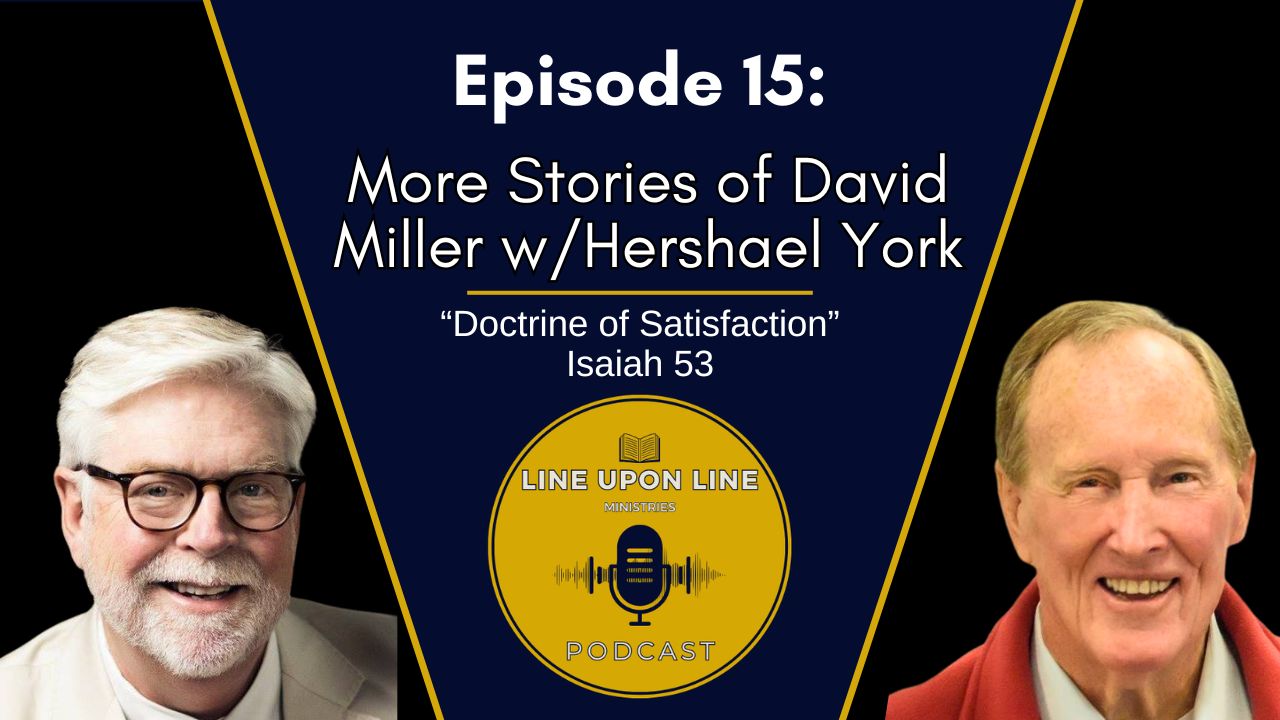


In this episode of the Line Upon Line Podcast, Dr. Hershael York shares more stories of his long friendship and shared ministry with David Miller. This is Part 2 of 2. Enjoy!
Bro. David Miller’s sermon: 🎥 👉 “The Doctrine of Satisfaction”, Isaiah 53
Recommended Resources:
1) Pastor Well – https://us.10ofthose.com/product/9798990660007/pastor-well-paperback
2) Preaching with Bold Assurance – https://amzn.to/4ahBN2E
Line Upon Line: www.lineuponlineministries.com
Email: lineuponlineministries@gmail.com
Social Media: @lineuponlineministries
Mark W. Williams: X @markwwill FB @markwilliamslive
Donate to Partner with Us: https://lineuponlineministries.com/donate
Episode Transcript:
[00:00:00] Speaker A: Laverne and Shirley used to be a show and there was a character on there named Squiggy and Tanya would do his hair like Squiggy.It would irritate him to death.
And one time we were at the SBC and we were on an elevator and Tanya, right before the elevator opened up, reached up and grabbed his hair and pulled it down and did like.
[00:00:30] Speaker B: Hello and welcome to another episode of the Line Upon Line Ministries podcast. My name is Mark Williams. At Line Upon Line, we are committed to the expository ministry of the Word for the life of the local church.On this episode, we have the second half of our interview with Dr. Herschel York and another classic sermon by Brother David on the doctrine of satisfaction from Isaiah 53. Before we jump into the second part of the interview with Dr. York, let me just say thank you to all of you who have listened and are commenting or reaching out to us with your, your memories or thoughts concerning the podcast, especially this last one with the first part of the interview with Dr. York. There were a lot of people who, who reached out and we’re encouraged by it. So we’re encouraged when you’re encouraged. So thank you for that.
Keep commenting and sending us messages. Email if you have any questions or comments regarding any of the podcasts or other ministry stuff and you can email me@ lineuponlineministriesmail.com also be sure to check out our social media YouTube website.
Be sure to, like, subscribe, do all the things.
If you’re listening to this podcast on one of the podcast channels, be sure to give us a five star rating and all that kind of thing. All of those interactions help spread the ministry of Line Upon Line to too many other people and encourage others with it. So let’s go ahead and jump into the second half of the interview with Dr. Herschel York.
[00:02:13] Speaker C: Any other, you know, favorite moments or memories that you might have of, of throughout the years. I know you guys did a lot of ministry together, you know, especially here, [00:02:24] Speaker A: but we did, you know, man, the four of us, Glenda and David and Tanya and I just, we loved each other deeply, immensely and we enjoyed our time together. And the relationship that David and Glenda had was beautiful. And I think Tan and I are, we have a beautiful relationship. And so the four of us together, just two couples who just absolutely delight in each other. You know, I saw Glenda looked at David the way Tanya looked at me, which is both adoration and frustration sometimes, you know, I, I saw that they had a real marriage, but it was, it was beautiful. It was glorious. And when Glenda got dementia, I don’t know. I don’t know if it was formerly Alzheimer’s, but it’s some form of dementia.And, you know, we.
It was during COVID and we just went, oh, we. We gotta go.
Before long, she won’t be able to recognize us. And so we went to see Glenda one last time while she still knew us.
And it was, I want to say, in August of 20.
So, you know, you’re still talking, everybody’s masked up and all that. And I was concerned, you know, boy, you don’t want to be the guy who takes covet in there that, you know, and kills David Miller, right? But, yep, you know, we just wanted to see. And David was just like, come on, man, don’t. Don’t worry about that. Just. Just come.
So we drove to.
To Heber Springs from here in Kentucky and just had a couple of final days. And Glenda was so sweet and precious and, you know, she still knew us really well, but, like, she’d be in the kitchen and, like, trying to fix lunch or something. She go, now what?
You could see she was struggling. Like, what do I do next? What I do? And Tanya would. Would help her, but just the way she would say, Hirsch. She always called me Hirsch.
Hey, Hirsch.
It was just so precious.
And, you know, I just wouldn’t take anything for that, for that relationship. And the four of us, I mean, I loved Glinda like a sister. I mean, she.
If David was a brother to me, she was every bit as much a sister. Tanya and Linda just had such delight in each other. Both of them very much same kind of ministry wife, very, very biblical and yet very involved and capable.
Both of them incredible Bible teachers in their own right and yet furthering the ministries of their husbands. So that, you know, that was just special to me to find kindred spirits like that that just delighted in marriage and in one another, in their children.
And I’ll tell you this, my son Seth, if he could be here, he would tell you, David.
David’s influence in his life is greater than anybody’s, with the possible exception of, you know, his parents, because Seth was at a time where he was really, you know, you’re a kid, grows up in a ministry home, at some point, you’re figuring out, do I really believe this stuff?
Do I want to go my own way? Do I love my sin? Do I love the Lord? All that. And Seth went through all that.
And David called one day out of the blue, and he said, man, I’m in Muscle Shoals, Alabama. And the guy that he had working for him had just left.
He and David was pretty much stuck. He said, I gotta have somebody fly here and drive me home in my rv.
He said, do you have any idea? Seth was at that moment asleep in a bedroom about 20ft from me right now.
And I said, well, and he was, Seth was, I want to say 19 or 20, somewhere in there.
I said, well, I could ask Seth. He said, do you think he’d be willing? I said, well, let’s see. I hollered in there and he came out. I said, david Miller and Muscle Shoals, Alabama, need somebody to work for him with him. Would you be interested? He said, yeah.
He talked to David on the phone.
David bought him a one way plane ticket. Seth flew down there and that night drove that RV in a rainstorm to Memphis, Tennessee from Muscle Shoals. He never had driven one before, but again, David just told him exactly what he needed to do, how he needed to do it.
And Seth did. Exactly. And David would tell him, he’d say, now look, if I, if you’re doing what I tell you to do and you drive this thing into a brick wall, you’re okay that it’s on me, but if you’re not doing what I tell you to do and it goes badly, that’s on you. And so he, he really conditioned Seth. Whatever I tell you to do, you do it. And that’s what Seth did.
And those, that year that Seth spent with David changed his life and just changed his life. It was great for him to have someone else speaking the truth in his ears other than me.
Sure, we had prayed for that. And the Lord used it to really help Seth get in a good place spiritually. He came back ready to marry man. He and he and Candace dated a very brief time and got married. And now the parents of four, four kids.
And there’s not a day that goes by that Seth does not quote either David or Granny Miller. David would often quote Granny Miller, Granny Miller would say, you know, you don’t have to stay stupid all your life, things like that.
And yeah, Seth’s kids are growing up hearing lots of David Miller and Granny Miller quotes every single day because David had a profound impact on Seth.
[00:08:59] Speaker C: Yeah, yeah. [00:09:00] Speaker A: What? [00:09:00] Speaker C: What? I mean, what a personal blessing that [00:09:02] Speaker B: is as a father. [00:09:05] Speaker C: You know, not only is he a good friend of yours, but he also makes, makes a big impact on your own kid. And that’s.And to see Seth now, I mean, he’s, he’s doing very well.
[00:09:15] Speaker A: And The Lord’s been incredible leader. He’s the director of a large Baptist camp. And, you know, he’ll have a staff of about 70 during the summer. And he is doing for those young people that work for him what David did for him.And this is what we do. We. We all pass it on. You know, somebody influenced us and we use that to influence others. And we’re hopefully standing in a long line of faithfulness until Jesus returns.
[00:09:42] Speaker C: Amen. [00:09:43] Speaker B: Amen. [00:09:44] Speaker C: Well, that’s good.So what would you say?
I don’t know if you have other things you want to share, but as far as you know David from, again, close friendship, many years, you shared a little bit about some of his personality and character. But what would you want people today who are watching David or thinking or seeing David, his sermons, those kinds of things, what would you want them to know about him? And what about him?
Would you. Would you hope to see more pastors today take on.
[00:10:20] Speaker A: Yeah. Well, I would say first of all, his. Well, there’s a lot but his fearlessness.He just didn’t give a rip.
You know, for instance, you know, David was Calvinist before it was cool.
Yeah. You know, before there was a young, restless and reformed anything, David believed the doctrines of grace and was preaching it.
And he’s been attacked for it through the years.
And he, you know, he had a couple of different ways of responding to that. He always tried to be gracious, but sometimes when people would be a little heated toward him, he could get that way back. You know, he could.
I was reading in Job this morning where after, I think it’s Zophar’s speech, Job says, no doubt you are the people and wisdom will die with you.
And David could have that kind of response. Oh, you’re the. You’re. You’re the people, and wisdom will die with you. You’re. I know, you know, you think you’re smart and he could get that way when somebody had a conference, an anti Calvinist conference, David could fire off a letter or say something. You know, he was fearless. He. And it didn’t matter if it cost him preaching invitations or whatever. He was just going to preach the truth as he saw it and, and show it in the scripture. He wasn’t committed to a system. He was committed to the Scripture.
[00:11:56] Speaker B: Right. [00:11:56] Speaker A: And I doubt David, I don’t know if he ever read Calvin’s Institutes. He didn’t believe anything because Calvin said it. He believed what he believed because he saw it in the scripture and he was fearless. And then that, that work ethic Just again, he had no tolerance for laziness.He just didn’t get lazy people.
And, and also the whole woe is me mentality, you know, people just the victimization that people sometimes felt and appealed to.
He just said, you know, here’s where you understand the providence of God.
That God has superintended the events of your life to make you like his son.
And you need to respond to those circumstances in a way that you are striving to become like your savior. And he just preached that and he was consistent about that.
Again, I’m sure he had his moments. If he did, they didn’t last long because he, he just, he could not afford to wallow in self pity long, you know, and every now and then he’d have a moment, but he just got over it and he’s like, you know, you can, you can whine or you feel bad about it all you want, it’s not going to change anything. You’ve got to do stuff. And so he, he just had such a work ethic and such a fearlessness.
He loved people and you know, any, he just cared deeply about people. He, I mean, how many preachers did he give a startup library to and get them, oh yeah, committed to expository preaching. This is what line upon line did.
He just modeled a careful, thorough study of the scriptures that you get up in the pulpit and show people the meaning of the text. And he did that. He and I, you know, it’s funny, we, we were so much on the same page. Even though he did not have the formal education I had.
[00:14:14] Speaker B: Right. [00:14:15] Speaker A: But that, that was never a thing. Both of us sort of came from the same kind of background and we resonated with each other.And I, you know, most of almost all my convictions I had before I went, I got a seminary education. I mean, I don’t ever remember not being a Calvinist. I mean my dad, I grew up reading the Puritans.
The sovereignty of God always made sense to me from the time I was saved when I was 7. I was reading the Puritans when I was 8. Dad and I worked through strong theology when I was 8 and Berkoff when I was 12.
So there’s just never been a time these, the doctrines of grace didn’t make sense to me. So I’ve always been there too. So that, that sort of tied us together and then our approach to preaching, that we were committed to expository preaching and yet, so I might have a little bit more like I would emphasize things like transitional sentences and he Would mock that. You know, the things that were. We did have a little bit of difference in our preaching methodology. Sure. We would have fun with.
And I would talk about transitional sentences and learn. Learning how to get out of one point, lean into the next. David would go, here’s my transitional sentences. That.
That’s point number one.
Here’s point number two.
Dr. York does not approve of my transitional senses, but I think they work fine.
[00:15:50] Speaker C: Yeah, I don’t think I read that in here. [00:15:52] Speaker A: So, you know, we would. Hilarious. We would have fun, stuff like that. You know, the other thing that really always blessed me about David, when we would do the. The expository preaching conference, he wanted me to do the session on delivery.And so much of what I talk about delivery is stuff he could not do.
Movement, gestures, those kinds of things.
And yet David believed that so much. I mean, even though he himself was physically limited. But one of the things I always pointed out to the people who came to the expository preaching conference was that David was smart enough that he knew, okay, I can’t do those things. I have to do other things even better.
So he was not one of these guys, a reformed guy who says, well, it doesn’t matter if you’re dull and boring. You know, the Holy Spirit will use it anyway. He didn’t believe that for a minute. And he figured out ways to keep the audience with him in, like, the. The way he would engage people go, are y’ all getting this?
If you’re getting this, nod your head like this. I mean, just a little thing like that to pull them back in if they’re drifting.
And he could use his. His eyes and his voice. You know, he was so deliberate in his speech patterns.
I brought him up this past week. I had a student who has trouble focusing.
He is a. It’s a genuine struggle in his life and how to stay on track for a sentence.
And I said, let me show you something. I showed him a video of David Miller preaching. I said, do you hear how slow and deliberate he is?
I said, you can do that. You. You can do that. Just take your time and be intentional like that. Finish a sentence before you start another one.
And David just knew exactly how to do that and his ability. I remember him preaching one time. He talks about.
He was preaching something about a yoke. He talked about as a boy watching somebody plow with a mule, and the mule straining under the. And the way he would lean and do his body. And he just make you picture the thing just by his description and his own posture his movement, his eyes, his description, descriptive language.
He. He was very intentional in the way he preached and very thoughtful in the way he approached delivery. And I think a lot of times guys think, well, if you just believe in the power of the Word, you don’t have to worry about that. David didn’t believe that. I don’t believe that. I think the best preachers know God has designed our minds to work a certain way, and good preachers know how to tap into that design.
What are the things that create interest? What are the things that make people lean in and want to listen?
And that’s what you’re. You’re using. You’re using those very things to get people to lean in and listen. And nobody was better at that than David Miller.
[00:19:13] Speaker C: Yeah, that. [00:19:13] Speaker D: That. [00:19:14] Speaker C: I mean, that’s everybody’s testimony when they see David is, you know, obviously the. [00:19:19] Speaker A: He. [00:19:19] Speaker C: The fact that he’s has everything memorized and he’s. And he’s speaking without any. Any notes or any distractions, that. That itself is engaging because he’s looking right at you the whole time. Like, there’s no. There’s no looking down, which I’m. I’m bad at. But anyway, he. [00:19:35] Speaker A: He. [00:19:35] Speaker C: His. His facial expression, he’s. He’s able to say more in 20 minutes than I say in an hour. [00:19:40] Speaker B: Of. [00:19:40] Speaker A: Of absolutely. And he spoke slowly, and he preached 25 minutes, and it would go by like that messages. [00:19:50] Speaker C: It would be 10 minutes long. [00:19:52] Speaker A: Exactly. And yet he said so much, and he was just really remarkable in that.I started to say he was gifted, but I think he would dispute that. He would say he worked at it, he thought about it. Yeah, yeah.
[00:20:07] Speaker C: He was very intentional about it, that’s for sure.Very engaging. I. I tell people when I grow up, I want to be like David.
When I finally get good at preaching on me like David.
[00:20:20] Speaker A: Yeah, well, that’s a. That’s a lofty aspiration. But I think he would tell you, you can do it.Yeah, yeah. I mean, he would. He would be the first to say there’s not anything special about him.
Everything he did, he did because he worked at it. He thought about it. He gave time and attention to it, and I think it’s both. And there is a natural giftedness that some people have and the ability to know one’s own personality and to use that personality.
I mean, David, you know, he did that. He knew who he was, and he was able to use that personality for the glory of the Lord. I think in his preaching, in his personal affect, I’ll Tell you something really funny.
This. This still cracks me up because we used to tease him about it.
You know, people would think they were doing him a favor when they would say, some times things that were just, well, indelicate. I don’t know how else to put it. One of them was a lot of times before when he would preach. Somewhere before he would preach, someone get up and say, I want to dedicate this song to you, brother David. And they would sing the song Hallelujah Square.
And it’s. It’s got a lot. A verse that goes, I saw a creature cripple dragging his feet he could not walk like we do down the street. I said, my friend, I feel sorry for you.
But he said, up in heaven, I’m going to walk just like you. And people would think that this was a good thing.
And David being so gracious, which, of course, he’d be sitting on the platform already while somebody’s up there singing.
[00:22:17] Speaker C: Yeah. [00:22:18] Speaker A: Because you got to be in place.And he would sit there and smile and nod his head the whole time like he was just loving it. And inside he was going, I cannot believe they did this again.
And so this was a running gag that I had with him and Tanya through the years is, you know, singing Hallelujah Square because, you know, irritated anybody couldn’t. He could not show that irritation. He was never going to straighten anybody out about that.
People thought that, you know, they meant well, but it was. It. It wasn’t well thought out.
Another thing, my wife Tanya could get away with doing more to him than anybody I’ve ever seen, because he, He. David had a streak of pride, you know, I mean, he was a proud man. They, like, he was fastidious in the way he dressed. You never saw David dressing sloppy. If he’s hunting, he’s wearing good hunting gear, you know, if he. And if he’s preaching, nice starched collar shirt, you know, the tie, tie just right, all that.
But Tanya would reach up and grab his hair and pull it down like Laverne and Shirley used to be a show. And there was a character on their name. Squiggy.
[00:23:36] Speaker C: Yeah. [00:23:37] Speaker A: And Tiny would do his hair like Squiggy.It would irritate him to death.
And one time we were at the SBC and we were on an elevator, and Tanya, right before the elevator opened up, reached up and grabbed his hair and pulled it down and did like, man, he gave. He gave her a look like, you know, I’m about to. He had. He had one weapon that he would threaten and he. He Would threaten to spit on you.
I never saw it. I never saw him do it, but I didn’t want to push him so far. No,
[00:24:14] Speaker C: never test that. [00:24:15] Speaker A: And, you know, Tiny would just go right up to the edge. You know, I think she assumed he won’t do it to a woman. I never assumed it, that he wouldn’t do it to me. So I didn’t mess with him that much. But anyway, those kinds of things that, as friends, you, you do sort of mock each other’s weaknesses and issues and all in.We, we would do that sometimes and he was a fairly easy mark in that way, but he, he knew how to give as well as he, he got, I’ll tell you that.
Yeah, and, and the Kentucky Arkansas rivalry, you know, especially basketball back in the days of Nolan Richardson. And we just had a good time with that.
And the last conversation I had with him before he died was when Calipari left Kentucky and went to Arkansas.
And he called me, ha, we got your coach. And I said, we’re glad you got him.
[00:25:16] Speaker C: He said, you can have him. [00:25:18] Speaker A: He said, herschel York, you are lying.I said, no, I’m not lying. We’re ready for him to go. We don’t think he’s been doing anything since 2015.
Hershel, you are lying.
No, David, we, we wanted him gone. I, I wish him every success at Arkansas. He was wanting to rub it in and I was like, I, you misunderstand. We’re ready for him to go. And that literally was the last conversation I had with him.
He, right after that, he, he got sick. He. I didn’t know he’d gotten sick until Josh called me the, the, the day David told him that he did not want artificial life support, that he, you know, that if he didn’t want to be intubated and all that to, well, not do extraordinary means.
[00:26:15] Speaker C: Right? Well, you’re not alone in that. I didn’t know he was sick until he was in the hospital. And on like the second or third day he was, he kind of kept all that kind of close to his chest and.Because I’m sure he had a, he had a lot of things going on, health wise, as you would expect from, from that. So, so even just the few years I was his pastor, he was in the hospital more than I knew about.
And, but yeah, that, that was, that was, that was tough.
[00:26:46] Speaker A: Yeah, he cared a lot more about Josh’s health than he did his own. Yeah, you look at his letters and stuff. He talked more about. Pray for Josh and talking about Josh’s challenges far more than he did his own. [00:26:59] Speaker C: Yeah, I bet. I. I think if, if, if Glenda was still alive and there was. There was some more that he needed to do that he, he wouldn’t have maybe said that. [00:27:12] Speaker A: Maybe said, you know, that’s exactly right. He was ready. He had been faithful to care for her. The Lord had taken her home and he was good. It’s like, you know, my dad used to say, only one man ever finished his work, and that’s Jesus. And you know, everybody else, we all leave with unfinished work and. No. And we do. But in the broad scheme of things, David had finished his work. You know, he cared for Glenda to the end and been faithful to that. He missed her.And he was ready to see his Savior. You know, he’s ready to hear, well done, good and faithful servant. And he, you know, he just stepped out of this. This world into the presence of his Savior after having a long, faithful ministry. And by the way, he lived far longer than anybody ever dreamed he would.
[00:28:05] Speaker B: Yeah. [00:28:06] Speaker C: Ever. [00:28:07] Speaker A: Yeah. [00:28:08] Speaker C: I think that that tenacity was, Was part of what kept him going.Intentionality. If he would have just been the oh, woe is me kind, he wouldn’t
[00:28:19] Speaker A: have made it as he would have died by 50. He would have died by 50.Yeah.
[00:28:24] Speaker C: Well, I. One of the, One of the great blessings I’ve had of ministry here at Tumbling Shoals was one of the first funeral I had to do when I came here was Ms. Glenda. And that was a joy. I didn’t get to know her without the dementia, but even still, she.You could tell there was something special about her. And I was in the hospital with her.
As you know, she was in her final days.
We would go in and we would start singing Amazing Grace and she starts singing the chorus with us.
[00:29:01] Speaker A: Yeah. [00:29:02] Speaker C: And it was, it was, it was just there. It was in her heart. It was. [00:29:05] Speaker A: I. I’ve seen it many times. My. But my mother in law and my grandmother in law both died with dementia. Same thing. Man, you’d be talking about anything else. They were just out of it. Then you start talking about the gospel of the Lord.Something came alive. You know, that outer man is wasting away day by day, but that inner man is being renewed.
And boy, that’s what a comfort and an encouragement.
[00:29:34] Speaker C: Yeah. [00:29:35] Speaker A: And I’ve seen that over and over. [00:29:37] Speaker B: Yeah. [00:29:38] Speaker C: So then when David Pass passed away and you know, we, we knew they were reunited there in. In glory. [00:29:45] Speaker A: We. [00:29:46] Speaker C: I was, I was, I was looking forward to preaching his funeral.And then Josh said, I Don’t want you to preach. Preach the funeral. And I thought, okay.
And then he said, herschel York’s gonna. So.
[00:30:01] Speaker B: Okay. [00:30:02] Speaker C: Yeah, I’m fine. [00:30:02] Speaker A: Then you. [00:30:04] Speaker C: I’m okay with that. [00:30:06] Speaker D: I will. [00:30:06] Speaker A: Glad. Yeah, brother, you did. [00:30:08] Speaker C: You did a wonderful job giving glory to God and, And. And honoring our dear brother David there at his funeral. And so for that, appreciate you. [00:30:19] Speaker A: I think had I died first, he’d have preached mine, so that’s good that you guys.Yeah, it was an honor.
[00:30:29] Speaker C: Well, brother, I don’t want to take up too much more of your time. I. We can always have another call later on if you have opportunity, but I, you know, we. We could talk for hours on expository preaching and ministry and all that kind of stuff, but I, I want to, you know, again, thank you for. For your time and, And. And let you get back to resting your. Your ankle and, And. And all that kind of stuff.I guess maybe kind of last thing here.
Is there any word for those of us who are our listeners, for those of us who are pastoring, preaching, you know, you don’t necessarily have to tie it to David, but just one piece of advice for us that, that are continuing to try to be faithful in ministry and preaching and leading in the church. Any sage words of advice besides go and listen to your podcast, because you got a lot of it over there.
[00:31:31] Speaker A: Yeah, but, you know, the. The older I get, the more I have just gained a single focus on our great purpose as being to glorify Christ.And I really think that if that’s the way we go about everything we do, how can I best bring glory to Christ in this?
Whether, you know, it’s dealing with a replaced ankle or preaching on Sunday morning, that really is the goal. It should direct our thoughts, our steps, our actions, our desires, our relationships, everything. And so that would be my great encouragement. Man, pray that you bring glory to Christ.
Preach in a way that brings glory to Christ.
Husband, parent, pastor.
Make sure that you’re making it about him, not about yourself.
And it’s for his glory, not yours, not earthly gain.
You’re not trying to gain followers or impact or any of that. Let that stuff happen.
Let the Lord do that. As a consequence of you seeking to bring glory to him or not, he may, you know, you don’t have to have influence. You just have to be faithful.
And I really want to encourage.
Guys, we’re in a world where we’re just. Are. We’re being discipled by screens.
You know, we’re. We’re being discipled by what we see on our telephones, on our computers, you know, and, and it’s just easy to lose sight of the great purpose for which we’ve been put here. And it’s to bring glory to our Savior. And that would be my great encouragement.
[00:33:25] Speaker B: Well, I appreciate that, brother. [00:33:27] Speaker C: Again, thank you so much for, for your time today. I, I know you could probably share all kinds more stories about, about David and I’d love to. To sit down with you maybe again and, and just talk. Talk shop. Expository preaching and ministry. [00:33:43] Speaker A: Yeah, I’d love to do that so that we can talk specifically about preaching, his preaching methodology and what he taught. I’d love to do that. [00:33:51] Speaker C: Yeah, that’d be awesome. [00:33:54] Speaker B: What a blessing it was to get to sit down with Dr. York and pick his brain about his friendship with brother David over the years.I want to also recommend another resource to you on this episode.
Dr. York has written a book called Pastor well. As you know, he has a podcast called Pastor well.
He wrote a book that goes along with that theme. So there’s lots of wonderful topics that will serve pastors well in that book, and I would encourage you to pick that up. You can find it in a link in the description below or on our website under the store.
And now let’s move to the classic sermon by Brother David, which is also a second part, sort of from Isaiah, chapter 53. On the doctrine of satisfaction.
[00:34:45] Speaker D: I feel as though I have been launched into the ministry.I invite you to turn, please, to the Old Testament book of Isaiah, chapter 53.
Our subject is the doctrine of substitution and satisfaction.
And I like both of them.
Who hath believed our report?
And to whom is the arm of the Lord written?
He shall grow up before him as a tender plant, and as a root out of a dry ground.
He hath no form nor comeliness.
And when we shall see him, there is no beauty that we should desire him.
He is despised, rejected of men, a man of sorrows, and acquainted with grief.
And we hid, as it were, our faces from him.
He was despised, and we esteemed him not.
Surely he hath borne our sorrows and carried our grief.
Yet we did esteem him stricken, smitten of God, and afflicted.
But he was wounded for our transgressions.
He was bruised for our iniquities, and the chastisement, the punishment of our sins.
The satisfaction that he made brought peace.
And with his stripes we are healed all. We, like sheep, have gone astray.
We have turned every one to his own way.
And the Lord hath laid upon him the iniquity us all.
He was oppressed, and he was afflicted, yet he opened not his mouth.
He is brought as a lamb to the slaughter, and as a sheep before her shearers is dumb, so he openeth not his mouth.
He was taken from prison and from judgment.
And who shall declare his generation?
For he is cut off out of the land of the living.
For the transgressions of my people was he stricken.
And he made his grave with the wicked and with the rich in his death, because there was no violence in him, neither was any deceit in his mouth.
Yet it pleased the Lord to bruise him.
He hath put him to grief.
When thou shalt make his soul offering for sin, he shall see his seed.
He shall prolong his days, and the pleasure of the Lord shall prosper in his hand.
He shall see of the travail of his soul, and shall be satisfied by his knowledge.
Shall my righteous servant justify many, for he shall bear their iniquity.
Therefore will I divide him a portion among the great, and he shall divide the spoil with the strong, because he hath poured out his soul unto death.
And he was numbered with the transgressors.
And bare the sin of many, and made intercession for the transgressors.
Hallelujah.
And glory to God.
In my previous sermon I gave you a brief analysis of the chapter.
I told you that in verses two and three we have his unattractive position in society.
There’s no beauty that we should desire him.
In verses 4 and 4 through 6 I reminded you of his unprecedented participation in suffering.
He was wounded for our transgressions.
In verse seven I reminded you of his unusual portrayal of submissiveness.
He opened not his mouth.
In verses 8 through 11 I told you about the unmistakable propitiation for sins.
He has made his soul an offering for sin.
In verse 12 we end the chapter on a triumphant note by noticing his unlimited undeniable power over Satan.
If you will listen well, I shall talk more about this after a while.
Now I have this six point sermon in two parts.
In part A, I gave you three items.
I talked to you about the indefensible wickedness of the sinner.
This text has told us that we are transgressors, we are iniquitous, we are wicked, we are sinners, we are existentialist. Philosophers have turned to our own way and we have heaped contempt upon the Lord of glory.
Indefensible wickedness.
Let us not suppose that we are cut from a different piece of cloth or made of any better stuff.
All of us are indefensibly wicked in the sight of a holy God.
I talked to you about the indescribable wrath of the sovereign God in his personality.
God in his character, in his essence is moved with a controlled, swelling, burning hot displeasure with holy and purpose. Antagonism toward sin and sin cannot be abstractly removed from our persons.
And thus God is angry with sinners every day.
I gave you these two.
When the smoke of the torment of the damned has ascended up forever and forever, it will not equal and it cannot rival the holy wrath of God that was poured out upon the sinless, spotless, superlative Son of God at Calvary.
That’s the doctrine of substitution.
That Christ has taken the place of wicked sinners.
And God, having accounted Christ to be sin for us in holy justice, has poured out his wrath upon his own Son.
God has sacrificed himself on our behalf.
I talk to you about the infinite wisdom of the Son.
Verse 11 says, By his knowledge shall my righteous servant justify many.
It is not knowledge about him, although that is required as a proper object for justifying faith.
The knowledge spoken of in our text is that knowledge which Christ himself possesses.
Who has known the mind of the Lord, who has been his counselor.
Who would have ever devised this scheme, that Christ, the Son of God, would be a substitute for sinners?
What tribunal, what hierarchy of ecclesiastical figures could have ever conceived that God would sacrifice his Son for sinners?
In so doing, he would satisfy the claims of holy justice, remove the seeming antagonism and incongruence between justice and love.
Christ knew how to work that out.
Glory.
Glory.
This has not been conceived in the mind and heart of man.
This took infinite wisdom.
Now, I might just point out for you that what I have done thus far is an excellent part of biblical exposition.
If you will learn to preach the Bible verse by verse and get off of your topical sermons and get off of your hobby horse.
You know the difference between a hobby horse and a regular horse, don’t you?
You can get off of a regular horse.
When you are preaching through a chapter a book of the Bible, you don’t have to be as concerned about introductory remarks.
You can just review for a couple of minutes.
And if it was good the first time, it’ll be even better the second time.
Now, I have three other items in the lesson.
I’m going to give you all three of them up front because I’m concerned about a couple of you, whether you’ll be with me at the end.
We shall come now to speak about the incontrovertible will of God.
And then we shall talk about the intrinsic worth of the substitute.
And then I will talk about the incomparable work of the servant of the Savior.
I call your attention to verse 10.
Yet it pleased the Lord to bruise him.
If you look further, at the bottom of the verse, it says, the pleasure of the Lord shall prosper in his hand.
In eternity past, the triune God held a meeting.
And God the Father sovereignly arranged our redemption.
And God the Son agreed that in the fullness of the times he would accomplish that redemption.
And God the Holy Spirit agreed that what the Father had arranged, the Son had accomplished, he himself would apply.
It’s called the everlasting covenant.
It is a part of the eternal decree.
God hath spoken.
His counsel will stand.
The cross was not an afterthought.
The cross was not the result of God jockeying around, trying to figure out what to do.
It is the will of God that His Son would die.
Are you aware that divine providence is able to govern, direct and uphold all creatures and all events yet so as not in any wise to be the author or the approver of sin, nor to destroy the free will and responsibility of intelligent creatures?
And even in the crucifixion of His Son as our substitute, as wicked, as sinful, as culpable, as the Romans were and the Jews were and the Gentiles, yet God in his providential will was orchestrating and arranging circumstances and events so as to bring about our eternal redemption.
It was the will of God that Christ should die.
In his Pentecostal sermon of Acts 2, Peter said it, like ye men of Israel, hear these Jesus of Nazareth, a man approved of God among you by miracles and wonders and signs, him being delivered. Listen now.
Him being delivered by the determinate counsel and foreknowledge of God, ye have taken, and by wicked hands have crucified and slain, whom God raised up, having loosed the pangs of death, because it was not possible that he should be holden of it.
In chapter four of Acts, verse 27 of A Truth, Lord, against thy holy child Jesus, whom Thou hast anointed, both Herod and Pontius Pilate with the Gentiles and the people of Israel. Israel were gathered together for to do whatsoever thy hand and thy counsel determined before to be done.
I want to tell you something, beloved.
The will of God is incontrovertible.
It cannot be questioned.
Now the heathen may rage, and the people imagine a vain thing.
But he that sitteth in the heavens shall laugh and have them in duration.
Pseudo intellectual theologians may write themselves a paper and declare that this notion of substitution amounts to nothing more than cosmic child abuse.
They know little about the will of God.
Now, notice the second thing.
I want to talk to you regarding the intrinsic worth of this substitute.
Have you ever wondered how Christ, in his physical sufferings, in his death, in his incarceration for three days in the tomb, could satisfy the claims of holy justice for an innumerable host of people?
How could he do that?
The wages of sin is death. Death.
Not just physical death, but eternal spiritual death.
There is this element of our guilt before God that is infinite.
We have sinned against an infinite God, and our guilt goes on and on.
How could Christ, how could one man consume, envelop, take upon himself all of this guilt without spending eternity in Hell himself?
Have you ever thought about that?
This text tells us two things about the worth of the substitute. It begins by speaking of his humanity.
He shall grow up before him as a tender plant and as a root out of a dry ground.
He hath no form nor comeliness.
And when we shall see him, there is no beauty that we should desire him.
But this speaks of his humanity.
I call your attention now to verse 11, the middle statement. It says, by his knowledge shall my.
What’s the word?
Shall my righteous servant justify many.
You see, there is what we call the hypostatic union of the divine nature with the human nature of Christ.
And the Christ of God is not just a man.
He is God in human flesh.
He is omnipresent, omniscient and omnipotent.
And yet it is not enough even to speak of his own omnipresence. For this is somewhat limited to time and space.
And the Christ who died for us existed before time and space.
The immensity, the infinitude of his being.
Before the worlds were called into existence, Christ, as an infinitely righteous one, was dwelling in unapproachable light.
Later created, intelligent moral angels said, holy, holy, holy is he.
You want to know how this man, as a substitute for sinners, could swallow up the wrath of a holy God?
It’s because of the intrinsic worth of his being.
There was enough worth and value in the person of God’s Son to have saved as many worlds of sinners as there are sinners in the world.
Are y’ all getting any of this?
Some of you are just sitting out
[01:01:21] Speaker A: there, [01:01:24] Speaker D: kind of like you’re in the ozone.Is this making any sense?
I just thought I’d check with you.
Now put that aside.
You like my transitional statements.
Look, don’t go to school forever trying to figure this out.
That’s the biggest waste of time.
Get you some points, get you some divisions. Analyze the text, and when you get through with one item, just announce it.
The folks will appreciate it and they’ll follow you along.
Now, here’s the third item.
I want to talk to you now regarding the incomparable work of the servant, the Savior.
Now, sermon outlines can be a little bit deceiving.
I have four items here.
Number one.
He accomplished satisfaction.
He shall see. God the Father shall see of the travail of the soul of his Son, and God the Father shall be satisfied.
It is the doctrine of propitiation.
A Baptist preacher who cannot spell and pronounce and explain propitiation ought to turn his ordination papers in.
It is the essence of the gospel of salvation that indefensibly wicked sinners are condemned before a holy God.
But God has chosen to deal with us in a substitute.
That substitute is His Son.
And in propitiation, Christ’s sufferings, the sprinkling of his blood upon the mercy seat in the heavens has caused holy justice to cry out, satisfy, satisfied.
And this has averted. It has turned away the wrath of God from our souls.
Tis done.
Tis done.
The great transaction’s done.
Holy justice is satisfied.
Number two.
He has acquired a seed.
He shall see his seed in eternity past. God the Father said, I will give to the Son these elect ones.
In his death, Christ purchased us.
The Holy Spirit then has caused us, has qualified us to be partakers of the inheritance of the saints in light.
James at the council in Jerusalem said it like this.
God is now visiting the Gentiles to take out from them a people for his name.
God intends to present the saints to his Son as his bride, as his inheritance.
This has been the work, the servant, our Savior.
Number three.
He has accumulated the spoils.
Listen to it.
Therefore will I divide him a portion among the great.
And he, the servant, shall divide the spoil with the strong.
Do you know what he did in his crucifixion?
He has conquered death.
He has conquered the grave.
He has conquered sin.
And he has triumphed over Satan.
In fact, he has put him to an open shame.
He has entered his domain and spoiled him.
Our God reigns.
Our God reigns.
And one of these days, with one wisp of his breath, he will consign the devil and the demons and their disciples to the bottomless pit.
He’s in charge.
I marvel at these preachers on television.
Listening to them, you would think The Lord and the devil were locked in the death throes of a spiritual battle and out in space and the outcome hadn’t yet been decided.
I want to tell you, when Christ died upon the cross of Calvary, he accumulated all of the spoils they belong to Him.
He is in session, ruling and reigning at the right hand of the Majesty on High.
But I’m not done yet.
He has accomplished satisfaction, he has acquired a seed.
He has accumulated the spoils and he advocates for the saints.
This great chapter closed with this and he made intercession for the transgressors.
Oh my.
Before the throne of God above I have a strong, a perfect plea.
The great high priest, whose name is love, ever lives and pleads for me.
My name is graven on his hands My name is written on his heart.
I know that while in heaven he stands, no tongue can can bid me thence depart no tongue can bid me thence depart.
When Satan tempts me to despair and tells me of the guilt within, upward I look and see him there, who made an end to all my sin Because a sinless Savior died, My sinful soul is counted free For God the just is satisfied to look on him and pardon me to look on him, Pardon me.
Let’s bow and pray.
Our Father, we exalt in these great truths.
Would you be pleased today to write these truths upon our hearts before our eyes for Jesus sake? Amen.
[01:10:55] Speaker B: I hope you’ve enjoyed this episode of Line Upon Line Ministries podcast. Be sure to like and subscribe and share this with anyone you think it will be an encouragement to. As always, if you have questions or comments, be sure to email me at lineuponlineministriesmail.com and God bless you as you continue to study and minister God’s Word. Line upon line.