
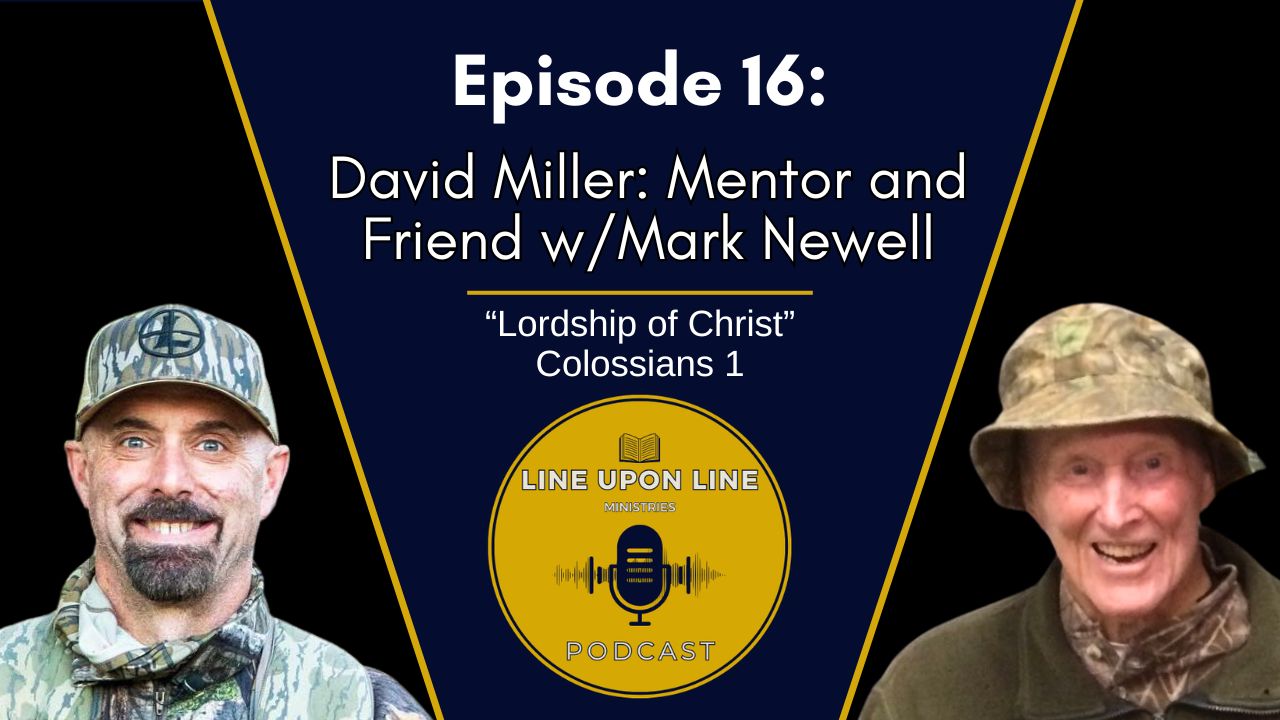


Ep. 16 – David Miller: Mentor and Friend w/ Mark Newell | Lordship of Christ
In this episode of the Line Upon Line Podcast, Mark Newell, Co-Host of The Bucks of Tecomate on the Outdoor Channel and rural pastor, sits down to discuss some of his fond memories of Bro. David Miller, hunting and outdoors, and ministry in the local church. Enjoy!
Bro. David Miller’s sermon: 🎥 👉 “Lordship of Christ”, Colossians 1:15
Recommended Resources:
1) Overcoming Anxiety God’s Way – https://amzn.to/3PEstOs
Line Upon Line: www.lineuponlineministries.com
Email: lineuponlineministries@gmail.com
Social Media: @lineuponlineministries
Mark W. Williams: X @markwwill FB @markwilliamslive
FULL EPISODE TRANSCRIPT:
[00:00:00] Speaker A: But if there was one thing about him that, that I wish that I could be better at, and we would all be better at if we was genuinely interested in people and to try to help people as much as you could. And that was Dot.
[00:00:22] Speaker B: Hello and welcome to another episode of Line Upon Line Ministries podcast. I’m your host, Mark Williams at Line Upon Line Ministries. We are committed to the expository ministry of the Word for the life of the local church.
On today’s episode, we have a special interview with a good friend, Mark Newell, as well as another classic sermon from Brother David Miller, this time From Colossians chapter 1 on the Lordship of Christ.
Before we jump into more of the content of today’s podcast, I have some exciting news to share with you.
I’m grateful to share that my new booklet, Overcoming Anxiety, God’s Way, is now available on Amazon.
I know that anxiety is a very real struggle for many people, but I also know that God has not left us without help.
In this book, I walk through Philippians chapter 4, verses 4 through 9 and show how the Lord meets us in our worry and fear with the truth of his word. And my prayer is that this booklet will encourage you, will strengthen your faith and help you find real peace in Christ, or if you know somebody who is struggling with anxiety, to help you, to help them.
And so you can find that on Amazon, there’ll be a link in the description, all that kind of stuff. Would love to hear from you, get any feedback. Any review on Amazon would be a great help to spread the word.
And now let’s get to the interview with Brother Mark Newell. Mark Newell may not be a familiar name to you.
Mark is the co host of the Bucks of Tecamate. I think I said that right.
If you’re a hunter and you watch hunting shows, you may recognize him. If not, you may not. But Brother Mark knew Brother David Miller over the years and, and recently we had Brother Mark at our church for a wild game supper. So we took the opportunity to sit down, talk about hunting, talk about Brother David. But Brother Mark is also a pastor in North Mississippi, so we had some opportunity to talk about expository ministry in local church.
I want to apologize up front. We had some technical difficulties with the microphones in the interview and we did our best to try to fix that. So enjoy this special interview with Mark Newell.
[00:03:01] Speaker C: I appreciate you coming and being here.
Real excited about the wild game supper. So thank you for taking the time to come all the way over here from North Mississippi and to minister to us here and to the people that are going to be coming tonight at Tumbling Shoals.
But I’m excited to sit down with you here and talk about Brother David. I know you knew him for many years and, you know, you kind of have a unique perspective that some of our other guests haven’t had. You know, we’ve had Josh on.
He’s got that perspective as a son in the home. And then I’ve had a couple other guys.
John O. Sims was here last year, and then Herschel York was the most recent interview that we’ve had. So. But you come as one that’s, you know, knows him more as a. Maybe just a friend, as a hunter, as a. But also as a student.
[00:03:59] Speaker A: Sure.
[00:04:00] Speaker C: And, you know, so I think the people who listen to our podcast would really enjoy hearing some of the stories you might have and get to get your perspective about David and what you learned from him and that kind of stuff. And so it’s kind of a wide open talk here, conversation about our good buddy brother David, and then just ministry in general and that kind of stuff. But, you know, we’re Expository ministry podcast. And so you are a co host of a TV show.
[00:04:36] Speaker A: Sure.
[00:04:37] Speaker C: That some of our listeners may or may not know about.
[00:04:42] Speaker A: Okay.
[00:04:43] Speaker C: Some might be coming to watch this podcast because they know you, which is great.
[00:04:46] Speaker A: Yeah.
[00:04:48] Speaker C: But some who normally listen may not know who you are.
Co host of the Bucks of.
[00:04:55] Speaker A: How do you say Teckamani? Tecamani. Yep.
[00:04:58] Speaker C: Okay. We’ve been saying it every wrong way.
[00:05:01] Speaker A: That’s okay. That’s typical. You can imagine those spellings that I get for it because you can’t sound it out to come up with that word.
And so. And there’s just so many different ways to run back. But just let’s just talk about teckamine for just one second.
And just the name of. It’s really cool. It’s that Spanish Indian word.
So, like, tecamani in Spanish is like a vessel or whatever, but the Spanish Indian is more like a basket. So the terminology by the people that lived out in the brush country of Texas, that’s how they described a deer. You’ve probably heard the terminology basket rack. Sure. Well, that’s what they’re saying. Tecomonte. Deer. Tecomonte. Tecomonte. Tecomonte. That’s what they’re saying. So they’re describing a whitetail buck is what they’re describing. Or at least a nice, decent whitetail buck with the basket on its head. And that’s where the name. That’s where the Name come from the
[00:05:58] Speaker C: Bucks of the Bucks.
[00:06:00] Speaker A: Right? The Bucks of the Bucks. That’s it. The Bucks of the Bucks.
And Tecumani years ago, was started back in the 1990s as a C company and we’re still as a C company. I’m a general manager of Takamati C company as well. And essentially what we were trying to do both in Georgia and in Texas, Texas primarily is try to find seed blends to grow big deer.
And trying to find a system to grow big deer.
And, you know, having good quality forage is the number one way to be able to do that. The better forage that they have, the better that they can express to the genetics that the Lord put in them. And that’s the cool thing about any deer. And you can read all kinds of crazy stuff on a bag.
You know, the Lord gives all of us essentially the genetics that’s in us. And it’s up to us essentially to get the best out of those genetics that’s in us that’s either athletically, mentally, or whatever that that may be. And it’s the same thing with, with the white tailed deer. So that deer can only be so big, but he has to have the nutrients, the nutrition to achieve the genetic potentials that’s there. And so many times, like here in Arkansas especially, the genetic potential is actually much better than people think. They just don’t get the nutrition. You have a lot of mountain country here, so. And there’s not a lot of high quality forage during the spring and summertime. That’s when they’re growing antlers in order to achieve a full genetic potential. I know at Dr. Miller’s place and Josh’s place, they’ve grown some big deer through the year, especially through some of the feeding programs that they were doing. And then CWD come along, then you couldn’t feed, and then the quality of deer went down. Why? Because they weren’t getting that nutrition. And you saw that a lot. You saw ways of that in certain areas. But no, just. So that’s what was going on there. So to back up just a little bit, to tell stories about Doc, the first time that I got to see him was in Camp Zion, Myrtle, Mississippi, One of these old school, you know, camp meeting events. I mean, it’s a historic thing that goes way back.
So I’m young in the ministry. I’m a youth pastor and I leave from our church. This is 20 plus years ago. And Dr. David’s one of the keynote speakers that’s preaching there at the conference. And I didn’t know him from anything.
So he rolls up there in his wheelchair, and he opens up and says, I want you all to turn to Second Samuel or something in the Old Testament.
And he goes to reading the text, and he ain’t got a Bible open.
So I’m sitting in my Bible, and it’s word for word, the entire chapter, whatever it was.
And I’m like, he’s not reading out anything. There’s got to be a teleprompter in the back. And this place is packed. And me, I have to look. I said, there’s got to be a teleprompter. I’ve got to look.
So everybody bows their heads to pray.
True story. Everybody bows their head to pray. And Dr. Miller is leading the prayer, praying over the text that he just quoted, essentially. And I’m. I gotta look. So I look back, no teleprompter. So he memorized. And if you know Doc, he’s very familiar and very famous for doing that, for memorizing scripture. And I’ve talked with Josh many times back in the day when Josh would be driving him, and he would say, hey, check on. Be sure I’ve got this memory, you know, check me. Be sure I’m quoting this correctly.
And so from then on out, I had to ask then my pastor that I was with, and I’m like, did he memorize that? Oh, yeah. He memorized every ounce of scripture. He was very familiar with Dr. David. So that was my first experience. Experience.
And I was just in awe of that. And then he goes into preaching, and it was just straight out of the text. And I’m like, this is brilliant. And y’ all know Dr. David’s mind. So then that started. So then I got to meet him, and him and I both had a love of wildlife, a love of hunting, and he knew my background.
And then just a.
An extended friendship started after that. Shortly after that, I got to go to his Line Upon Line conference.
And it was a phenomenal school, mostly young preachers he would bring in. He gave us thousands of dollars worth hardback books that I still have to this day. And then we had. I think it was three, four days of a conference.
And he had several different guest lectures there, but it was all about preaching out of the text. And I’ll never forget this. He said, you should never preach no more than one topical sermon a year. I’d rather not preach that you preach one. But if you do only preach one that year.
And then it was at that point, too, is when we Would break up in these smaller sessions. And then one of those smaller sessions, luckily, he handpicked me to come to his house and we were able to talk about scripture, able to talk about the Lord, but also able to talk about hunting.
And this was before I was co hosting the show or anything like that. I was working part time in a lot of that as well.
And, you know, we had this shared love. Actually got to go over to his property, said, hey, will you come over to my property here outside of Heber Springs, out in the country out there. Beautiful property out there, out at the farm. Absolutely. So I got to go with him and Josh out there and we rode around the farm, give them some ideas on things that they could do with their food plots and things. So. And then again, so from all of that, you know, we would share hunting stories and, and all of that with Doc, which was just, you know, phenomenal. And then it got to the point where every time that I would come and visit with Doc, it was like a relief for him because, yes, we’re both in the ministry.
The way I preach so much come from him and him saying, stay in the text, stay in the text. And then my pastor, brother Don Smith as well, they were really good friends also. He was the same way. So I got both of those voices in my head to this day. Don’t get out of the text.
If you do that. I don’t care what comes out of it. You’re going to be good if you stay in the text because that keeps you safe. I’ve even told our kids with that same ideology about. You have all this political stuff now about what do you believe in homosexuality? What do you believe in all this? Who cares what you believe? What does the Bible say?
And just say, well, I believe the Bible and this is what the Bible says. That’s all you have to explain. You don’t have to give your personal opinion. You give God’s opinion.
And that’s the way we are as preachers. We’re giving what God says, not what I think is what God says. Thus saith the word. And that’s what Dr. Miller had such a great ministry in doing that. But the cool thing is when we would get to meet and just talk, it was like a relief for him. Because us preachers, sometimes we need to step aside from the ministry at times. It is great for us to talk about other things, you know, like hunting for an example. It’s a relief from, let’s just say, the business side of preaching. And it just is. And of course, Doc traveled all over the country, you know, and sometimes, you know, he just want to talk about hunting and not the, you know, the doctrine of grace or the doctrine of whatever, or talk about somebody’s problems or whatever. And he was great at doing that. And if you asked him with that, he definitely would try to help you. But for me and him, it was like you could just tell, oh, here’s a kindred spirit. Let’s just talk about hunting. Let’s talk about deer management, let’s talk about all this other stuff. And that was the cool thing that if there was any little thing that I could bring to Doc was just a little bit of relief and we could talk about other things, but besides ministry type things, there was a lot of times where I would just call him, like, hey, Doc, have a problem with this text? I have a problem with this situation. What do you think about this? Well, what’s the text? And then we would go through all that. He was always very gracious on doing that.
So so many different stories with him from starting on as a young pastor. And then when I. When I was started doing the TV show stuff, he just thought that was the coolest thing ever. And like, oh, now I know a celebrity. I’m like, no, dog. I know celebrity. Okay, you’re this. You’re always the celebrity.
So.
But just a lot of that, you know, with Dr. Miller, and he will always be, you know, at the forefront.
You have kids and I have kids, and, you know, we have kids in our churches and things, and, you know, they have heroes or whatever. But I’m just telling Dr. Miller is a hero of mine and I think a hero of Minnie’s, and not just from the, obviously the preaching side of things, but the hunt.
I was always been so impressed on what he was able to do on the hunting side of things. You know, cocking that crossbow. He had somebody to cock it. And then the way he was pushing that thing to aim it and then blowing through that straw to be able to do it, he didn’t let any of that getting down. You know, he was always figuring out a way to do something. Josh is the same way now, you know, so.
So you have both of that instilled in their DNA that, by God, we’re going to do it. We’re not going to let this disability, I don’t even want to call it that. Let this hindrance. Let’s just say that get me down. So that’s impressed me. And anytime when I would get down or feel bad about myself, like, look, Dr. Miller’s doing this in a wheelchair.
I’m just stupid, you know what I’m saying?
I feel dumb by thinking about it, you know, man, get after it, you know, so. And one of the things, too, that I remember with Dr. Merriler telling us in that conference is the idea to work hard. Always work hard. Work hard with your sermon, work hard with whatever to try to better yourself and better your family. And he’s saying that in a wheelchair. And he was doing it. Josh is the same way, you know, man, he’s got all these rent houses going, and he’s hands on, you know, he’s right there with them, trying to tell them how to do, you know, right there.
[00:16:44] Speaker C: The state for 12 or 13 years.
[00:16:47] Speaker A: I mean, absolutely.
He’s just constantly wide open. So both of them had that DNA, and that’s just always impressed me. So when I feel lazy, man, I just don’t feel like doing that. I’ll think about Doc, you know, and then, you know, so he just always instilled hard work. And then here lately, with the particular sermon series, a couple different ones that I was doing went through there in Romans, doing Marks of a Christian. I like doing things with Mark.
[00:17:16] Speaker C: It’s a good name.
[00:17:17] Speaker A: So Marks of a Christian.
[00:17:22] Speaker C: They’re all good things.
[00:17:23] Speaker A: Oh, and I have a series also about John, Mark, When God Makes His Mark. It’s a phenomenal story there, but I relate it to me. When God made, took the person made me as well. But I remember there’s a text of scripture there that says, don’t be a sluggard. And the Greek breakdown of that. Don’t be lazy and don’t be late. And when I read that, immediately thought of Dr. Miller, you know, I’m like, this is what he was saying as a preacher, don’t be lazy. Study, be prepared. When you get up there, be ready to go.
You know, as a provider, do that. So all of those things, you know, that’s what Dr. Miller instilled in me as a young preacher growing up. And those are things that I’ll never forget and I’ll constantly try to pass on as much as I could, you know. And I was telling our church folks about coming here, and I’m like, man, I would have loved for Doc to be able to come here. It’s a country church in Mississippi where I pastor now, and it’s a small church, but, boy, Doc had a heart for those small churches. And I thought, man, he would love y’, all and y’ all would love him. And Told some stories about Doc, but.
[00:18:36] Speaker C: So I’m sure he would have if
[00:18:38] Speaker A: he had the chance. Oh, absolutely.
[00:18:41] Speaker C: All over the place, he was telling stories about some of the.
The places he would go to. You try to get there. It’s, you know, you’re backwoods. You’re definitely backwoods.
[00:18:53] Speaker A: Absolutely.
[00:18:54] Speaker C: Now, where is your church?
[00:18:55] Speaker A: It is.
Try to give a bigger. Because it’s. It’s Podunk. It’s in Porterville, Mississippi.
It is close to Scuba, Mississippi Scuba. Kind of got famous for Last Chance University there on ESPN there for a long time.
And it’s north of Meridian, Mississippi, so that’ll kind of maybe help some folks paint a picture where that is. It’s about two hours from where I drive where I live, so I drive about two hours every Sunday and most every Wednesday. So. But it was just one of those things where. And the Lord says, I need you here. So.
And he’s made it work. Not to say that I hadn’t been tired, but again, some of that Dr. Miller instilled in me, hey, get after it, you know, so. All right. Don’t be lazy. Don’t be lazy.
[00:19:46] Speaker C: And there’s no, you know, no small church, no small job to do. You know, if you got to get there, it takes you two hours or it takes you 12 hours, or it takes you driving across the state to get to do what God has told you to do.
Do it.
[00:20:02] Speaker A: Yep. Absolutely. Absolutely. Well, I have a.
I have a crazy. Again, just paint some more background so folks can kind of understand. And I have a theology degree and a biology degree, so it’s a really cool mix of the two things. And boy, I tell you, in some of those classes, they’re exact opposite. So you had to fight against a lot of crazy stuff in some of those classes. But the Lord’s taken both of those things and been able to use them to a great, great degree.
So now, just so folks can know, I guess about nine, 10 years now, been hosting show. We actually have two shows. It’s the Bucks of Tecumani is on the Outdoor Channel.
Then right now, Tecumani Whitetail Nation is on the Sportsman’s Channel. So we have two different TV shows. We have Bucks of Tecamani, YouTube that we’ve really just now getting going, because you got to do the YouTube thing now, so you can go straight to YouTube and you can find some stuff. It’s not a lot of stuff on there right now, but it’s. We just hired a new guy to really keep that populated.
You can go to Social Media, Facebook, Instagram, buckstek, Amani. You can find us on. On all of those outlets there. And I’m very thankful with that.
My co host, David Morris, great Christian man as well. And we’ll talk about business, we’ll talk about family, but we can also talk about the Lord. And that is a great.
Just a great thing to be able to do within the company.
Unfortunately, there’s a lot in the outdoor industry that you can’t do that with, so. But I’m very, very thankful that a lot of our standards come, you know, come from the Lord first and foremost, and then it’s, you know, flows after that. So very thankful with that. David actually, too, goes and speaks at a lot of these events. He’s getting older now. He’s in his 70s, so he can’t get out and go quite as much as he used to do.
But I’ve had a great time being able to do that. And it’s tough to try to juggle everything, but the Lord’s made it work there at the church. Have a great, you know, a great associate pastor who fills in Scott, if you watch this. Appreciate you, brother.
So anyway, and I’d already told him, I said, I plan on being back Sunday, but just in case, he’s like, I got you. I got you. And he always does. Does a great job with that.
Absolutely, absolutely. Yep, yep, yep. So, yeah, no.
[00:22:34] Speaker C: Do you have any kind. You know, maybe like one or two just favorite memories of hunting or, you know, David, I know you shared some of that just now of some of the ways you connect and that he’s influenced you. But, you know, just. You have any favorites moments with David?
[00:22:54] Speaker A: And it’s. Yeah. And it’s really the simple things, like one of the times. And I got to go to the farm several times with him, and it’s really the simple things like that that comes to mind. There was one time him and I were out there talking. Of course, he had. He had a book and he was reading. Dr. Miller read a lot.
So we’re out there on the farm and he was reading some particular book.
He also had his little iPad or something up there that he was trying to memorize some scripture as well. So, I mean, multitasking and these are just things that are sticking in my mind. So I guess it’s not these crazy memories. But then after that, how we just talked about biology, and he just drilled me with biology questions.
And we were out there on the farm. Beautiful day. He had some of his workers picking up rocks and his food plot if you’ve ever been out to the farm, you know, this is mountain country out here, so any fields are full of rocks. And he had some guys out there, that’s all they were doing was picking up rocks. So we were watching them pick up rocks. He’s sitting there reading this book.
He is trying to memorize scripture. And he’s also asking me biology questions about deer and all of everything about the forage, what he needs to be planting, what, you know, way his soul is. Do you need a disc or do you need to. And just all of that just impressed the snot out of me. And for him to be asking.
Him to be asking me a question for information to me, because, again, he’s one of my heroes, and for him to ask me anything, for him to say, there’s knowledge that you have that I don’t have, and I want to obtain that. To me, that was special.
So, yeah, there’s some other stories and stuff that we can tell. And us riding around the farm and going through some sketchy place. I’m like, doc, I don’t think we need to be. Ah, we’ll be all right, you know, so he didn’t. He didn’t care. All kind of crazy stuff like that. But what really impacted me, I’ll just never forget that out there is a beautiful sunny day, and we’re just out there talking deer more than anything. And we’re doing that as he’s doing all that other stuff, which to me, I mean, just multitasker impre. I mean, just all of that kind of stuff just. Just weighs heavy on me. And I think about a lot.
[00:25:30] Speaker C: Yeah. That makes me think, you know, how can I.
I just can’t seem to find time to read my Bible.
[00:25:36] Speaker A: I just can’t seem to exactly memorize scripture exactly. Yeah.
[00:25:41] Speaker C: David did it while he was doing everything else in life.
[00:25:43] Speaker A: Yes.
[00:25:44] Speaker C: At the same time.
[00:25:45] Speaker A: At the same time. And that’s what he was doing. Hey. We would be sitting there talking. Wait one second. Hey. You be sure you get right over it, you know, I mean, hey. Well, hey. Nope, you need to get back over here and do this right here. Hey, come over here. I forgot. I need you to do something. And that’s with us doing everything there. That was Dr. David. And that right there made me help mold me into the way I act, the way I react, the way I do things. And so that voice in the back of my head or that image in the back of my head of being diligent, you know, we’re to be diligent as pastors, we’re to be diligent in everything that we do.
There was a picture of that.
And if anybody had excuse not to, it’d be him.
No, like I said, it was that kind of stuff right there. That it’s the fondest memories that I have of him.
[00:26:41] Speaker C: I’m reminded of the passage where Paul says, imitate me as I imitate. You know, sometimes people try to be churchy, will say, we don’t follow a person, we follow Jesus. Okay, well, that’s great. But you want to find people in your life. Life that are following Jesus.
[00:26:56] Speaker A: Absolutely.
[00:26:57] Speaker C: You want to imitate. Sure.
And David was one of those guys. I’m sure. He definitely was for me in the way it sounds.
[00:27:04] Speaker A: Sure.
[00:27:04] Speaker C: Just like that for you as well.
[00:27:06] Speaker A: Yes.
[00:27:07] Speaker C: Yeah, he. What an inspiration he was to just. To sit with and learn. Glean from just watching him how he’s living.
[00:27:15] Speaker A: Sure.
[00:27:15] Speaker C: Watching what he’s doing, how he’s acting, how he’s, you know, all while keeping the Lord at the center of it and doing all these other things.
What an inspiration that is.
What
[00:27:32] Speaker D: an ideal.
[00:27:35] Speaker A: Yep.
There’s another funny story. I’ll share this. It really don’t fit into anything, but Dr. Miller was at Algoma Baptist Church preaching, and I was youth pastor and associate pastor there for 16, 17 years, and he was preaching there, and he pulled in in his big motorhome and there were several ladies from the church. Rolled his motor home with toilet paper. Yeah, rolled it.
I mean, covered it. He was asleep and at night, they covered it.
He thought that was the greatest thing. He got the biggest hoorah out of that.
So, yeah, I don’t know if Josh was there on that one or not, but I’ll have to ask him. But, yeah, so that’s still a font. They still talk about that to this day. That was years ago. But that’s 20 plus years ago. I don’t know how long ago it was, but anyway. But they.
Yeah, he got up and it was just covered. They covered the entire thing in toilet paper. And then right there in front of it, they had pieces all toilet ripped.
It’s hilarious. And so there’s a funny story there, but he thought that was the greatest thing ever in the roll TP in an rv, you know, so. But that was just kind of the character. Some of those ladies that grew up, they were always doing crazy things to each other.
[00:28:55] Speaker C: So, of course, David loved it.
[00:28:57] Speaker A: Oh, he loved every bit.
He loved every minute of it. So, yeah, that kind of humor. Yep, yep. So,
[00:29:09] Speaker C: so you mentioned a few of the, you know, the things you learned from him over the years.
How. How has that. You know, you’ve been, you’ve been now in Ministry for 20.
[00:29:21] Speaker A: 20, let’s say 20 plus, right? Yes, sir.
[00:29:24] Speaker C: When did you first go to the preaching conferences? When did you first.
In the middle of that. Was that before?
[00:29:32] Speaker A: That was right at the beginning. When I first saw him was in the beginning. So you’re talking. I’m trying to think of the years. They go by pretty quickly.
So you’re talking 25 plus years ago that I got to see him there. And then it wasn’t long. Within a couple years after that, I was here at Tumblin Shoals at his conference.
So, no, it’s like I said to this day, the way I develop an outline, the way you put the text as center stage and then allow those thoughts to come out of the text.
All of that from Dr. Miller and again, Brother Don Smith, my pastor at the time then was the same way.
That’s what I mean. That affects me with everything. I don’t know, going back to topical sermons.
I preached very few in my entire. Because of that. Because you don’t have to.
You don’t have to. You want to do a topic? Sure. Take a text and preach the topic. You know, that’s why you do it.
Exactly 100%.
You know, why even try to do all of that?
And it’s much easier that way than it is trying to jump all around and grab thousand different texts or whatever. You don’t have to. Let’s just take this text and roll with it. Yeah, you can use some other texts to help support it, but you don’t have to do that to build your sermon. And I’ve learned that. And part of learning that was from Dr. Miller.
And so I’m one. Forever be grateful. And that is from Sunday school class material. I taught Sunday school or youth? Youth and college. Sunday school. We had older youth in college. It was kind of a weird pairing there, but just way the dynamic was at the time at our church 20 years ago, we did an older youth and older high school in college. And it just, it just stuck, you know, so.
And I did the same thing with the, with the Sunday school stuff. That whole development is, well, we’re going to take this text and we’re going to teach all of that, because if you’re not careful with that, that can get really, really topical, you know, with that type, with a lot of those curriculums. And again, I’m instilled textual, not topical. So. So with everything from Sunday school curriculum that I helped developed and did develop to sermons, you know, so much of that was Dr. Miller in my ear, you know, and I can’t, I can’t thank him enough for those things. So
[00:32:19] Speaker C: besides your own, you know, obviously your.
The way it has affected you personally in your ministry, you know, in preparation and what you choose to preach through and all those kinds of things, how have you seen that make an impact in the church?
[00:32:37] Speaker A: Oh, my goodness. Phenomenal impact.
You know, with just to.
And you know this.
People want to hear truth.
Regardless what they say, people want to hear the truth. And sometimes the truth’s hard to hear, but people still want to hear truth. And I’ve seen. We’ll just. And there’s so many different ways I could go back. I don’t have time to tell all the stories.
But just from our church now, the past couple years in our church, I mean, it was down to where it was just a handful of people coming.
And a couple people told me this, look, man, we were starving to hear the truth. We were starving to hear the Word.
And it has nothing to do with me. It’s all about to do God’s Word. But we’re doing diligence to present it in a way. And that’s what Doc would always say.
And so you saw from 10 or 15 to now, and I know this doesn’t sound like a lot for a lot of churches now, 50 or 60, that’s there. We go from one Sunday school class to four Sunday school classes. And it’s all just because the truth is being developed in a way that they can digest it.
And that was just one of the things that Doc would always say as well. You know, take time, develop your points so people can understand these points. Keep sermons shorter. You know, people have a shorter attention span. So it’s not quantity, it’s quality.
Brother Don said the same thing. Choose your words, your points.
So I’ll spend. I don’t know if I’ll have the sermon done, but then again, I have it in my mind. All right, is this the best word you know, that I could choose here? Are these the best three words that I can make in this three point or the best five words in this five point outline?
And then you’ll think of a better word. Oh, that’s going to resonate. Or I’ve even changed them up, especially doing talks like this.
I’ll change up some words because I think it’ll hit better with others.
And it’s Just that kind of. All of that right there goes back to Dr. Miller. If you’ve listened to any of Dr. Miller’s sermons, one of my favorite things that he always did, when he would introduce it away and he’d ask the question, are you interested? How many times have you heard that? Are you interested? And then everybody’s like, yeah, we’re interested.
[00:35:10] Speaker D: Exactly.
[00:35:11] Speaker A: So just little things like that, little mannerisms like that, man, just help tremendously.
Both the way you develop that sermon, but it’s the way the listener hears it and the way the listener develops it and then can apply it to their lives and then make them want to come back for more. They want to come back for you. They’re wanting to come back for the word of the Lord.
And as David writes, the delight in the word, the honey, all of the sweetness of God’s word, basically the idea, hey, it’s enough there, that makes you want to come back for more.
As a pastor, there’s some harsh things that we have to preach sometimes, but for the most part, we should preach the word in that way that people come back.
So that’s the impact that I’ve seen. When you preach the word textually, when you take your time and choose the right words to describe the text and things of that nature, it takes care of itself. It really does. And it just blows my mind when you see these TV preachers doing other things. And I’m like, what are you doing, man? I mean, come on. So anyway, that’s just what I’ve seen and the feedback that I’ve had. And then on a lot of the Sunday school, you know, one of the things, and I’m sure you’ve seen this through ministry a lot of times one of my focuses was I’ve got to keep these kids after college or keep these kids in college, because a lot of times they get into college, you lose them, and you may not see them back to multiple gym. 30s, after 30s, maybe even 40s, 50s, before they come back. There was a whole age structure of kid of age dynamics, I guess you could say that we were missing. And I’m like, okay, here’s my goal as this Sunday school curriculum with God’s word is to keep them here, you know, keep them engaged, to keep them here, you know, and. And you got to see that a much higher percentage of them now were there again, had nothing to do with me. It was just.
I’m like, what, what, what are we doing now? And what can we do differently to try to hold them there and expository preaching works even in that dynamic.
All of those particular things I’ve got to see from the youth side of things, even to the older side of things.
If we could just all get back to preaching line upon line, what David’s life work was all about, my goodness, we’d all be better off, you know, as churches, as pastors, as people, as dads and so on and so forth.
[00:37:58] Speaker C: Yeah, I agree, obviously.
But now you also have.
No, a lot of pastors also have other jobs.
[00:38:10] Speaker A: Sure.
[00:38:11] Speaker C: You know, bi, vocational, I guess.
[00:38:12] Speaker A: Yes.
[00:38:13] Speaker C: The terminology, you know, you are, you have this entire wildlife outdoor side of your life that takes up a majority of your time.
[00:38:23] Speaker A: Takes a lot of time every week.
[00:38:25] Speaker C: I’m sure the expository preaching line upon line even helps with it, does it all.
So you’re not trying to guess every
[00:38:34] Speaker A: week what am I going to be
[00:38:35] Speaker C: and what am I going to pull out and all that kind of stuff. But I’m curious, how does some of that expository preaching ministry, understanding, you know, of the word and how that impacts people and yourself even, how does that interact with your day to day stuff? Like do you see that impacting how you work with the wildlife stuff with the outdoor Channel and that kind of thing?
[00:39:02] Speaker A: Oh, absolutely. I mean, you know. Well, we’ll just back more of a
[00:39:08] Speaker C: question of how are you a Christian in everyday life?
[00:39:12] Speaker A: No, in particular.
[00:39:13] Speaker C: You know, understanding expository preaching has very practical benefits, not just for preaching, but life, 100%.
[00:39:21] Speaker A: And I would just use one word for that and it’s the standards that it develops in your life.
And I try to teach this to kids and my goodness, the Bible is full of those standards and we’re trying to go through some of those with a lot of our studies as well.
God has a standard for us to live by.
Us preachers have a standard. And one of those standards was Dr. Miller. It’s a pretty good standard to try to live up to and I don’t think none of us would ever live up to that. But it’s a pretty good one to try to strive for, like you had mentioned with Paul.
But there’s just standards in life and standards of living. And you compare that to look at our country. Our country used to have such a high standard standard for everything. For example, there used to be a standard for the dollar. It was gold. There’s no more standards for that. And we see the economy is crazy.
There were standards for the military, you know, and they’re bringing some of those standards back now, thank goodness. You know, but you just saw everything from educational system, there were standards. When I went to school, you had to make a 93 to get an A. Now it’s a 90. Some places you can even make an upper 80s and they’ll round it up close enough.
At one time it was a 95. I remember was an A back when I was going through elementary school. And then I remember it going to a 93. I’m like, alright, two points. And now it’s a 90 or whatever it is. So I’m just seeing in general our world, we see standards lowered and we see God’s word being the great standard. And then you see people trying to belittle that and that’s what expository preaching will do. If you stay in the text, that standard will always, you know, regardless if you’re living it, preaching it, whatever, that standard’s there. So that carries over into life. And there’s some things that I’ll just have to tell people that I’m not going to do. I’m not crazy about alcohol, none whatsoever. I’m not buying it for you, you know, I can tolerate it. Sometimes you have to tolerate it.
But if you want to go get it, you can go get.
I’m just saying. So there’s certain things, and now they know that I don’t drink and they respect that or whatever. I’m just using that as an example. And there’s other things as well that, you know, things that are definite we’ll just say off putting for an example. And I’m like, well, this is the standard. But it’s amazing when you, when you set that standard and you set it hard, you’ll see it affect their lives more really than it affects yours because then they won’t partake in as much of those things.
So standards is so important. And I think that we have at every level of society lowered our standards in so many different ways.
And we just need to get back to the Bible, we need to get back to the book.
And if you stay in that text, then there you go.
I’m going through now, I think I mentioned to you and us talking, going through the Book of Acts, looking at the history of the church. God has a standard for the church.
I don’t know why we’re trying to change so many different things and lower that standard for the church.
God’s not lowered that standard.
God’s plan for the church then is the same thing for the plan now. Do we do some things differently? Absolutely. But those standards haven’t changed, you know, but you see a lot of that being changed, and I have a problem with that. So we’re studying line upon line, and that’s what. Like this will answer your question.
I know what tomorrow’s sermon is going to be or next week’s sermon is going to be, because it’s whatever I finished the Sunday before, I’m going to pick right back up right there. Sometimes I’ll go back over something again just to make sure, you know, that everybody’s on the same page before we move on to something else. So it’s really easy. And I may have three points and I may only do one. That’s fine. Good. I got number. I’ll start at number two tonight, you know, you know, I’ll tell them, like, well, we’ll be. Y’ all have to come back tonight to get this next one. You know, like, man, I really was hoping you’d get to that. We’ll come back tonight. You’ll get it. You know, and then the same thing on Wednesday night, just doing a completely different study there.
I try when I can, just to tell you, just to try to help different people.
If I’m in a New Testament study on Sunday mornings, I try to do an Old Testament study on Wednesdays. On Wednesday nights through. We call it a Bible study. Ends up being more preaching than anything.
So just to give me balance. Not really for the church, it’s more for me than anything.
So I can be studying in both of those things to help balance God’s word. So I don’t know if that answered your question at all, but that’s just kind of what I thought about when you said that.
[00:44:23] Speaker C: Yeah, I mean, you know, we.
What. Whether. Whether you’re a celebrity on. I’m going to call you celebrity.
[00:44:33] Speaker A: What Dot would always do, like, oh, come on, Doc,
[00:44:37] Speaker C: you know, you’re working at Walmart. I mean, what we are preaching and teaching on Sundays is not just for Sundays, you know. And so us who are preachers, pastors who are teaching, you know, we have to live the rest of our life throughout the week as an example of. Sure. What we’ve been teaching 100%. That doesn’t mean the person sitting in the pew shouldn’t also be living those things out. And so. Absolutely, you know, I was asking you about how expository preachings made an effect in your church. But, you know, that. That’s kind of that where those things, oftentimes there’s a. There’s a disconnect.
People think of the church life and then they think of the rest of their life.
But when you’re thinking about the scripture as the standard, it’s not the standard just for Sunday, for all of life.
[00:45:26] Speaker A: Absolutely.
[00:45:27] Speaker C: You know, and so for some of us who work at Walmart during the week.
[00:45:33] Speaker A: Sure.
[00:45:35] Speaker C: How you work day in and day out has got to be according to the standard.
[00:45:40] Speaker A: Absolutely.
[00:45:41] Speaker C: When you’re recording with the Outdoor Channel, there’s still a standard.
[00:45:45] Speaker A: Absolutely.
[00:45:46] Speaker C: Just because you’re doing that doesn’t mean. Okay, well, I can lower the standard doing these things.
God has given us his word and that’s why we need to be teaching it.
[00:45:55] Speaker A: Absolutely.
[00:45:56] Speaker C: Be preaching it like we do. Because it’s not just so that we have something to teach, you know, it’s not just so that we don’t have to look for something next week to preach from.
[00:46:06] Speaker A: Sure.
[00:46:07] Speaker C: It’s because we know that this is sufficient.
[00:46:10] Speaker A: Sure.
[00:46:10] Speaker C: For all of life and godliness. It has everything. It is the standard, just like you said. So.
[00:46:15] Speaker A: Yes.
[00:46:16] Speaker C: I was just curious how it was, how that is, how that works out in your, in, in the particular.
You know, I don’t know anything about TV shows.
[00:46:29] Speaker A: Sure.
[00:46:30] Speaker C: The whole, you know, system of how that works. But I’m sure knowing something about Hollywood.
[00:46:40] Speaker A: Sure.
[00:46:41] Speaker C: Not always pretty on, on backside.
[00:46:43] Speaker A: That’s right.
[00:46:44] Speaker C: On the other side.
[00:46:45] Speaker A: So.
[00:46:46] Speaker C: Sure. You had to make some.
[00:46:47] Speaker A: Oh, absolutely.
Well, and the thing is too, I’ll just say just give you a little background, you know, from that. You know, it’s, it’s, it’s not just, oh, you, you get to.
All you get to do is shoot deer for a living. That boy, that must be a great job. I said I wish that’s all I did, you know, because the product. Yeah, exactly. Because the production side of things and to be able to try to tell this story and all the behind scenes stuff that you do, it’s work a lot of times and it’s a job to be able to crank it out and then crank it out continually, you know, so. And we’ve been. I just thank the Lord too for our success and I think the Lord has.
With David and I having standards, David and I, you know, proclaiming the gospel. Dave and I live in the way the Bible says we live and know that we have a crunch of time or whatever to get these things done.
He is. We’ve been very successful, maybe more so than any other producers that’s out there because we talk with them a lot and you know, to be able to do that, what we do and be successful at it because most of the time I got a week to get a big deer shot where everybody else has got the whole entire year. I got a week to get this deer shot on this particular property that may be 5,000 acres. And a lot of times, it’s one particular deer that you’re hunting. You know, it’s a whole lot easier when it’s any mature deer. But so many times we’re hunting a deer and. Or maybe one or two, three at the most deer that’s, you know, that. That we want to shoot because we’re trying to shoot a certain age and then a certain size on these particular properties.
And you see a lot of deer, but trying to find that deer, I mean, it’s still hunting the very best. And we have great properties that we manage, either properties that we. We have or properties that we’re managing for other people that we get to hunt.
And it can be difficult. You know, here you are paying a camera guy, and you’re trying to do all this stuff. Stuff, and then, you know, at the end of the day, the movie star’s got to show up or you don’t have a show, you know, so we’ve been very, very fortunate, you know, to be able to do that. And I think I just. I mean, I just offered up to the Lord. I’m like, I think the Lord’s watching out for us because we.
The numbers, we shouldn’t be as successful as we are being.
And because it’s hunting at the end of the day, so.
And just to be able to constantly crank these things out, I’ve just been amazed, you know, at it now. We’ve not successful every time, but we’ve been successful at a higher percentage than the typical hunter. Definitely way higher than would be. So.
And then a lot of that, too, goes with our preparation in everything. Just like preparation and us as pastors. And, yeah, there’s work involved, so. And that’s, you know, and there’s. There’s a lot of work behind the scenes there, too. And there’s way more work preparing than it is hunting. But still, you know, again, that. That big deer’s got to show up. But I give credit for the Lord for that, for helping us be as successful as. As we have through the years, and I’ve been amazed at it. So. And because I talked to a lot of these other outdoor creators, and they’re putting a whole lot more hours in to get the shows that we’re cranking out, and I just thought, well, okay, you know, thank the Lord’s all I can say. So it’s been a blessing there. Yes, sir.
[00:50:28] Speaker C: Have you ever taken David, like, on a hunt, or is that.
[00:50:31] Speaker A: No, I never got to actually hunt with him, and I wish I could, but I never. We never got to hunt together. We had talked about it several times, him coming to Texas, but those last few years, of course, with his wife passing and then with his health, that kind of boogered a lot of that up towards the end, we had some. He’s like, I want to come to Texas. I want to come to one of yalls places. I’m like, all right, come on. You just say when we’ll do it. And we talked about it, and just the time wasn’t there for him to come, unfortunately, so. Wish we’d have started that ball rolling earlier than that, but. Yes, sir.
[00:51:06] Speaker C: Well, I mean, as far as the hunting goes, this is.
[00:51:10] Speaker D: This is.
[00:51:11] Speaker C: Has nothing to do with David or anything else, but you’re about to walk into our church where every mount that that is hung is either David’s or Josh’s.
[00:51:21] Speaker A: Oh, wow.
[00:51:22] Speaker C: And so you’re gonna see some. Some pretty big deer.
[00:51:25] Speaker A: Oh, yeah. Oh, yeah.
[00:51:27] Speaker C: You having been, you know, they may not be quite so big. So I’m just curious, what’s the biggest whitetail deer you’ve ever.
[00:51:36] Speaker A: I’ve got a couple in the 200s. Wow. Yes, sir. Yep. So a couple pretty nice deer on some of my ranches in Texas.
But again, you’re talking.
You’re talking about pouring a lot of resources, a lot of management, you know, passing them up when they’re really big, hoping that they can be world class, you know, and most of the time, about half the time they do. And, you know, because we’re letting them get.
I mean, most of the time, you’re talking six years old before we can shoot them. And the two bigger ones that I shot, they were both seven and eight, you know, and there’s times where, you know, they die, unfortunately. We’ll pass them up, and they’re giant. And then you get all kind of crazy stuff on social media, but that’s just part of it. Or the neighbor shoots them. That happens, too. We had a couple of really giants that.
Oh, it hurt when they shot them, you know, but typically, we kill more of the neighbor’s deer than they kill of ours because we got better groceries, typically.
But it happens, you know, it just is what it is. So.
But so just been very fortunate to be able to do that. And it’s. Yeah. And that’s what we’re known to do, is to grow Big deer. Typically, I don’t get to shoot them. It’s usually the other guys that gets to shoot them, but.
But we’re great. And being a wildlife biologist that’s on that side of things, it’s actually my favorite thing to do. It’s not necessarily kill one, but it’s to grow one.
So. And I’ve got to grow.
Just see the potential to see a client kill one or, you know, see what a property can produce.
And at the end of the day, for me, that property turns into the trophy. That’s for me, you know, because that’s where all the work came. That’s where the planning came. To be able to take a raw piece of property and to be able to see that diamond, to see that finished product before, you know, the first ounce of sweat that’s dropped on it, and then build it up to that, and then you get to see those big deer get shot. Or if you’re looking for a lot of turkeys, if that is there, whatever your gold is, for the property, to be able to see that gold achieved.
And I’m like, awesome.
That’s what I enjoy.
That’s the fulfillment. And as much as I love to shoot a big deer and to grow a big deer, My favorite thing in the world still is turkey hunting.
[00:54:05] Speaker C: Oh, really?
[00:54:05] Speaker A: And that’s coming next? Yeah, that’s coming next. So we got one guy.
[00:54:11] Speaker C: I don’t think he’s feeling well right now, but he may or may not be here tonight. But we’ve got a big turkey hunt.
[00:54:16] Speaker A: Oh, really? Cool.
[00:54:18] Speaker C: He’s the only one.
[00:54:19] Speaker A: Yeah, yeah.
[00:54:21] Speaker C: He’ll get a kick out of you, I’m sure.
[00:54:22] Speaker A: Oh, I bet, I bet. But I just. I mean, that’s. That is my passion, if you ask my son. So what would you rather do? Turkey hunter? Deer hunt? He’d say turkey hunt. They’d say, why? Because deer don’t gobble. That’s what he’ll say. So. And that’s the cool thing about turkey hunting. It’s more of an interactive type sport. You get to call and, you know, you know, conjuring in, you know, you had something to do with deer. It’s more passively hunting, and you’re waiting to come out in a food plot or in a road or whatever. Now you can call and stuff, rattle. We’ve done that. I’ve rattled in bucks in Texas. And that’s fun. You can grunt them up and stuff. But that’s more rare of a thing with turkey.
You’re pretty much always trying to do Something. Now, you can sit in the blind and wait them out, just like deer. But most of the time, you’re interacting with them, and that’s what’s fun. You get to see them strut and they gobble and all of that kind of stuff.
[00:55:18] Speaker C: You get to take your son on a lot of hunting.
[00:55:20] Speaker A: I do. I do. He gets to go.
He loves Texas. He would move to Texas tomorrow if I told him.
But we’ve taken several trips. He’s been to Kentucky and killed deer.
But Joshua, he’s got another Josh. So Joshua has actually killed a turkey on the Miller farm several years ago.
Oh, yeah, I forgot I sent you those.
So one of the things we’re trying to do with Joshua is to kill a turkey in every state.
So when he was four years old, he killed a grand slam of turkeys, which is a Turk.
We have four subspecies of turkeys in the United States, and he killed four of those in one year. And he’s the youngest on record to have one done. That’s been documented because we videoed every single hunt.
And I videoed it for two purposes. One to document it and then two, to show people that it was actually him killing them and not me.
So I had a GoPro on him, and then I’m videoing the turkey. I’m like, here it is.
Because you can imagine the social media warriors you get, oh, you didn’t shoot those turkeys. I’m like, yeah, he did.
So he’s killed 13. He’s nine years old now, and he’s killed turkeys in 13 states.
[00:56:35] Speaker C: So we have turkeys in every state.
[00:56:37] Speaker A: We have turkeys in every state but Alaska.
So it’s called the 49. That’s what in the turkey world call it. Or they. I think they call it Super Slam now or something like that. Or the world, I don’t forget. No, it’s not world soup. I think it’s the Super Slam. So. But it’s killing turkey in every state, and that’s a big deal now where people. It’s getting harder to do, too.
It’s just. I don’t know, the turkey population is not quite as good as it used to be because there’s a lot more turkey owners out there and a lot of other reasons as well, but. And then there’s some states. It’s getting harder and harder to hunt for out of state to get those licenses and places. But anyhow, yeah, preferred method is it
[00:57:18] Speaker C: gun or is it bow, or.
[00:57:19] Speaker A: I’m a gun guy now. I used to bow hunt quite A bit then.
But I’m. I would rather. I’d rather rifle hunt. And mainly it’s because of the TV side of things. Again, we got a week to get it done, you know, so as David would say, I ain’t got time to.
[00:57:39] Speaker C: It’s got to be good.
[00:57:39] Speaker A: I ain’t got time to play with him. I’m ready to kill him, so. But I enjoyed. I mean, I enjoyed bow hunting. I really did. And if I didn’t do the TV side of things, just the way we.
A lot of our huntings in Texas, you know, big open country or whatever, where it’s a little bit harder to bow hunt. You can bow hunt those areas, but it’s a lot harder to. And it takes more time. It takes more man hours to kill the quality deer that we’re trying to kill.
So we hunt with a rifle, and I kind of like it.
I’ve shot them with crossbows and stuff, too. That’s fun, too. That’s a whole nother to me. It’s a whole nother sport. That’s. That’s even different. You get to get close, but you can pull that trigger. You ain’t got to worry about pulling it back. So that’s fun, so. Yes, sir.
[00:58:24] Speaker C: Bad stories from this year’s hunting three with a crossbow this year.
[00:58:30] Speaker A: Oh, it can happen.
It can happen. You can. Oh, yeah.
[00:58:34] Speaker C: I’m not. I’m not a great hunter, but I try anyway.
[00:58:39] Speaker A: Yes, sir.
[00:58:41] Speaker C: Well, cool.
I guess just kind of maybe bringing all this to a close.
[00:58:49] Speaker A: Oh, no question.
[00:58:51] Speaker C: You know, just bringing it back to you. To David.
As much as, you know, this podcast, this ministry is Brother David. You know, over those last year, as we’ve. We’ve kind of kicked. Kind of re. Kicked off the ministry. Sure. David never did any of the online stuff, any of the Sharon videos and podcasting and all that kind of thing. There’s been a lot of people who. Who have come to come to know David over the last year about him before. Never heard of him. Somebody might even listen to this podcast right now and don’t have a clue who David is, except that, you know,
[00:59:27] Speaker A: we’re talking about him, right? Absolutely.
[00:59:29] Speaker C: So if.
If there was one thing you would want people to know about David, just maybe personal, that you just. Just even just how he’s personally impacted you, or you just want people to know about him, what. What would that be?
[00:59:51] Speaker A: Oh, my gosh.
To do one thing. Oh, my goodness.
Yeah.
[00:59:57] Speaker C: I’m not mad at it.
[01:00:01] Speaker A: To genuinely be interested in people because Doc was.
He was Interested in people. And I’ve just watched. He would. He would personally, as he would. The way he would connect with you, you’d never forget him. You never forget that experience.
And I’ve tried to do more of that. Be genuinely interested in people. That’s from the congregation to the lady at the Wendy’s Drive thru. Be interested in people. And it’s amazing the impact that that has.
That’s part of the impact that he had on me early on, before I even knew who I was. He was always interested, and it wasn’t just me. It was everybody.
Everybody that Doc come into contact with. He was genuinely interested in them. What do you do?
What’s your family life? What do you like to do? He would just hit you with all those questions. I saw it.
And just from the side would see that. And yeah, there’s a lot of big things, obviously, his mind, his brilliant mind, his love of the outdoors, you had all of those things that we have in common.
But if there was one thing about him that I wish that I could be better at, and we would all be better at if we was just genuinely interested in people and to try to help people as much as you could, and that was Dot, you know,
[01:01:24] Speaker C: So I agree with that 100%.
[01:01:27] Speaker A: Yeah.
[01:01:28] Speaker C: When you came in contact with David, you didn’t forget it.
[01:01:30] Speaker A: You did not forget it, and he didn’t forget it. That’s the impressive thing.
I remember you from such and such Baptist Church 22 years ago. I’ve heard those stories, you know, him saying that, and I’m like, yeah, I see why he genuinely love people. Yes, yes.
And that’s the thing. And that was one of the things, the marks of a Christian was to be genuine. And when I give that point, be genuine in your life. Be genuine with the people. Be genuine with our contact with others when you’re genuine.
There’s so many phonies out there today. And you mentioned the Outdoor World. There’s a bunch of phonies in the.
There’s a bunch of phonies in all of it. But in the outdoor World, there’s a whole lot of people that would like to talk the game Christian and like to say this and say that or whatever. And then you’re around them, like you mentioned, I tell some stories, and they’re like, really? Okay.
But it goes back to the idea of being genuine. When people will respect the idea of you’re genuine, they can see that you’re real.
And that idea, Doc, was that in every sense of the word, every sense of that whole ideology and if we could be more genuine in everything that we do, you can draw people, people will be drawn to you, be drawn to what you got to say, what you have to offer then.
And as Christians, if we could just be more genuine, you know. So anyhow, I agree with you. Part of that I learned from Doc, man.
Yeah.
[01:03:13] Speaker C: I appreciate your time today.
[01:03:14] Speaker A: Absolutely.
[01:03:15] Speaker C: We can talk more with you, you know, looking forward again to the wild game stuff.
[01:03:21] Speaker A: Absolutely. Me too.
Totally my pleasure.
[01:03:24] Speaker C: But thank you so much for your time, man.
[01:03:29] Speaker B: It’s always a joy to speak with those who who knew brother David during his lifetime and to talk about expository ministry in the church with like minded brother.
Now let’s go to a classic sermon by Brother David Miller on Colossians Chapter 1, on the Lordship of Christ.
[01:03:53] Speaker D: Would you turn please to the New Testament book of Colossians, chapter 1 and verse 15.
I shall preach to you regarding the lordship of Christ as it is revealed in this text.
Speaking of our Lord, the Apostle says this in verse 15 who is the image of the invisible God, the firstborn of every creature.
For by him were all things created that are in heaven and that are in earth, visible and invisible, whether they be thrones or dominions, or principalities, or powers.
All things were created by him and for him, and he is before all things, and by him all things consist and he is the head of the body, the church, who is the beginning, the firstborn from the dead, that in all things he might have the preeminence.
For it hath pleased the Father that in him should all fulness dwell and having made peace through the blood of his cross by him, to reconcile all things unto Himself by Him I say, whether they be things in earth or things in heaven, and ye that were sometime alienated and enemies in in your minds by wicked works.
Yet now hath he reconciled in the body of his flesh through death to present you holy and unblameable and unreprovable in his sight.
If ye continue in the faith, and be not moved away from the hope of the Gospel.
My sermon has no introduction and it has no conclusion.
To be more specific, it has no beginning and it has no ending.
You might ought to be praying. It shall not be eternal.
I’m just going to start, and when I sense my time’s up, I’m going to stop.
I’m a little embarrassed to tell you that I only have two points in my sermon.
Doesn’t hardly seem right, does it?
I want to give you the meaning of lordship and then I want to give you the manifestations of lordship.
Our text.
What do we mean when we say that Jesus is Lord?
Verse 15 says that he is the image of the invisible God.
Jesus is the visible manifestation of the invisible deity.
He is the essence, excellence and effulgence of deity.
He possesses all of the divine attributes.
Whatever characterizes the nature of deity, it also characterizes the nature of Jesus Christ.
He is Lord.
He is risen from the dead, and he is Lord.
But it is not his being resurrected from the dead that makes him Lord.
For he was Lord before he ever died.
It’s the fact that he was Lord that gives significance to his death.
He possesses not only the divine attributes, he possesses the divine authority combined all of the power and wealth and prestige of presidents and prime ministers and potentates.
And it’s like a drop in the bucket compared to the Lord Jesus Christ.
It’s like the fine dust on the balance that one wouldn’t even bother to wipe away were he about to make a meticulous measurement.
Now, have you noticed everybody believes in Jesus these days?
Have you noticed that Hollywood believes in Jesus?
Politicians believe in Jesus.
Until you begin to assert the reality that he is the Lord Jesus, that he is God, of very God.
That’s who he is. Now, that’s the first half of my sermon.
What did you think I expected? Resounding amen.
If for no other reason than it was brief.
But if you thought that was half of the sermon chronologically, you have greatly erred in your judgment.
Now, I want you to see four manifestations of Christ’s lordship in our text.
First, he is the Lord.
Creation.
He preceded Creation. He is before all things.
Now you tell me when was the creation, and I will tell you that Jesus was before that.
Board an intergalactic spacecraft and traveled back into time.
Traveled back to Bethlehem.
Jesus was before that.
Go back to Moses and the giving of the law.
Christ preceded that.
Go back to the Garden of Eden. Eden.
And Christ was before that.
Traveled back into eternity past traveled that unnavigated ether that had never been disturbed by the brush of an angel’s wing.
And Christ was before them.
Go back to when there was no time.
And there you will see him in regal splendor, in unapproachable light, enjoying the fellowship of His Father.
Tell that to Hollywood.
He’s the Lord.
Creation came about according to the power of Jesus.
He spoke when as yet there was nothing and the worlds were framed into existence.
Creation came about according to his purpose, and it’s for his pleasure.
And it’s governed by his poverty, by him.
All things consist, they cohere, they are held together.
The writer in Hebrews says that by the word of his power, he upholds the unity and the harmony and the balance of the created order.
You and I live in a cosmos rather than in chaos because Jesus is the Lord.
What would you think if I held up 10 silver dollars and I asked my grandson Malachi to come here with a bright orange magic marker and number them in your presence?
1, 2, 3, 4, 5, 6, 7, 8, 9.
And I dropped those into my pocket, and I tell you now, I am going to fill in my pocket without any scheme or design, and I am going to select the coin with the number one on it and I hold it up for your viewing. Would you believe I had done that by chance?
Give me a break.
It’s only 1 in 10.
Folks go to Las Vegas or over to Tunica and they gamble their life savings away on odds greater than 1 in 10.
Suppose I drop that coin back into my pocket and there are 10 again.
And this time I pull out the number two coin.
The odds now jump to 1 in 100.
I put it back into my pocket. This time I select the number 3 coin. The odds jump to 1 in 1000.
Would you believe I was doing it by chance?
Don’t you trust me?
Stranger things than that happened three or four weeks ago. Eric and I were down in Valdosta, Georgia. Did you hear about those tornadoes?
We’re sitting out there in the motorhome.
Just five miles north was a terrible tornado.
Just two miles south was another tornado. Strange things happen.
One in 1,000 on the number four coin, the odds jump to one in 10,000.
On the number five, they jump to one in 100,000.
On number six, they jump to one in a million.
On number seven, it’s one in 10 million.
Number eight. One in 100 million on number nine.
The odds are one in a billion. That’s with a B.
On number ten, the odds jump to one in ten billion that I could pull ten coins out of my pocket. One out of ten, each time in sequence.
One in ten billion.
And yet they say that Christians are naive for believing that. That Jesus the Lord was the agent of creation and governs its unity and harmony by the word of his power.
Are y’ all getting any of this yet?
He’s the Lord of creation. Number two.
He’s the Lord of conversions.
And you that were sometime alienated and enemies in your minds by wicked works, yet now hath he reconciled in the body of his flesh through death.
I have now been a preacher, a participant and an observer in Baptist life for 52 years.
It is my opinion that we are in the midst of a famine.
It is not a famine of bread nor a thirst for water, but of hearing of the gospel.
I fear that we have adopted what I call the Madoff Ponzi scheme of church growth.
By that I mean we have reverted to methodologies that allow us to bring in enough new people through the front doors to make up for all of those whom we lose out the back door.
And all the while we have kept this scheme going, hoping that no one finds out.
But the truth is, we have been found out.
Today, Southern baptists number over 16 million members.
But on the Lord’s day morning, less than half of these will even bother to attend worship at the house of God.
Today, if your life depended on it, you and I could not find 4 million Southern Baptists. Literally, they are missing.
We wouldn’t have a clue where to begin to look for them.
They tell us that by age 18, 80% of our converts occur.
Consequently, we spend much of our time, energies and resources trying to reach this particular demographic.
But when these 18 year olds graduate high school and go off for college or careers, we promptly then lose 80% of them to any active participation in a local church.
The one area where we have enjoyed some increase in baptisms is among 4, 5 and 6 year old.
Someone asked me the other day, do you believe that Calvinists baptize infants?
And I said no, but they’re dang close.
They’re baptizing 4, 5 and 6 year olds.
Not only am I opposed to baptizing infants, I’m opposed to baptizing folks who can’t articulate the gospel.
How are we going to resolve this dilemma among us?
I tell you we ought to begin by repenting.
Repenting for dumbing down the gospel.
Repent for preaching a gospel that doesn’t offend the sinner.
For preaching a man centered gospel rather than a God centered gospel.
For preaching synergistic regeneration rather than a work of God alone.
We ought to repent for being enamored with power prestige.
Ought to repent for wishing Hollywood would make us another movie that we could use as an evangelistic tool.
I tell you, I’m out of the old school.
I believe when the lights go out at the church, that’s a good sign. The powers are.
I tell you, most of this Hollywood crowd, if you took the F bomb out of their vocabulary, they couldn’t give you their name and Address.
Why do you want to bring that stuff into the church?
Where’d we ever get the notion if we could just get Miss Alabama to be a Christian and be a Baptist, we could get her on the pastor’s conference circuit, make the gospel more relevant.
If the preacher would just take his jacket off, get him a Hawaiian shirt, get him a gold chain, spike his hair, use a little peroxide, we could make the gospel of the Lord Jesus Christ more relevant.
I want to tell you, you can’t make human depravity less relevant than it already is.
And you can’t make folks who are guilty because of Adam’s transgression and came into this world possessing original sin.
You can’t make them any more adamantly opposed to the gospel than they already are.
Did you hear what this text said?
And you that were sometime alienated and enemies in your mind by wicked works, yet now hath he reconciled. You want to know how he went about reconciling enemies to himself?
He became a substitute for sinners.
He took the blame and bore the wrath in his own body.
The judgment that should have been on you and on me.
He fulfilled the righteous demands of the law and suffered the curse of the law until holy justice had cried out, I am propitiated. I am satisfied. It is enough.
And it’s this gospel of the depravity of the human heart, that men are dead spiritually and cannot activate themselves.
They’re defiled morally and cannot rehabilitate themselves.
They’re dominated satanically and cannot elevate or liberate themselves. They’re debilitated volitionally and they’re never going to be able to figure out God. And they’re damned eternally and cannot exonerate themselves.
And we must go to them with this liberating message. Jesus Christ, the Son of God, the Creator of the universe, has condescended from heaven’s glory to earth. Shame. Now, why would he have done that?
Why was not the blood of bulls and goats sufficient to take away sin? I’ll tell you why. They did not possess a nature equal to the nature of those who had offended God, nor did they possess a nature equal, equal to the God who had been offended.
It was necessary that the Son of God come down and veil his humanity in human flesh.
He could be equal to those of us who had sinned and equal to him who had been offended by our sin. Be a dazed man. Bring the two of us together.
Believe on him, trust him. Bend your knee, bow your heart before him, and you shall be saved.
This is the word of the gospel, which is incorruptible seed by which the Spirit of God births men into the kingdom of God.
Number three.
You like my transitional statements?
Quit going to school trying to learn how to do that.
You get through one item, just announce it.
I’m done with that. And here’s the next one.
I want you to see that Jesus is Lord in the church.
Verse 18 says, and he is the head of the body, the church.
Now, a church is a local, visible congregation of Christ’s baptized disciples who are united in the belief of what he has said and are coveting to do what he has commanded.
Metaphors are used.
Sometimes the church is referred to as the building, the body, or the bride of Christ.
But locality and visibility are inherent in these metaphors.
Did you ever know of a universal, invisible building or body?
And may the dear Lord have mercy on the man who marries a universal, invisible bride.
I don’t know about you, but I like something more tangible in a bride.
This notion of a universal, invisible church is the figment of some theologian’s imagination.
It doesn’t exist. Never has existed, never will exist.
Where does it meet, for heaven’s sake?
What are its ordinances?
Who is this Pastor Benny Hinn.
Kenneth Copeland.
Creflo Dollar.
Did you ever know of a televangelist more aptly named than Creflo Dollar?
What are the missionary, evangelistic and educational enterprises of the universal, invisible church?
Now, I want to tell you, beloved, the church of the Lord Jesus is local and visible. Where the saints come together, organized around the authority of scripture, coveting to do what the Scripture commands. Jesus is Lord of the Church.
He’s the source of our attractiveness.
Let us preach Him.
Number four. He’s Lord of the consummation.
It hath pleased the Father that in him all fullness should dwell.
And having made peace through the blood of his cross by him to reconcile all things unto Himself.
By Him I say, whether they be things in earth or things in heaven.
History is not cyclical, going around in circles.
You don’t have to be looking over your shoulder to see what’s coming up behind.
It’s moving in a linear fashion from its consummation. Or, pardon me, from its commencement to its consummation. Your best life is not now.
Your best life is yet to come.
Keep your eye upon the eastern sky.
One of these days, ere long, the trumpet’s going to sound.
And the dead in Christ are going to be raised first.
We which are alive and remain are going to be caught up in the clouds to meet the Lord in the air and so shall we ever be with the Lord.
Hallelujah and hasten the day.
Let’s bow and pray.
Father, thank you for your word. Write it indelibly upon our hearts before our eyes for Jesus sake.
Amen.
[01:31:08] Speaker B: I hope you’ve enjoyed this episode of the Line Upon Line Ministries podcast. Be sure to like and share if you believe this will be an encouragement with others. Would also love to hear from you. As always, you can email me at lineuponlineministriesmail.com Be sure to check out the website for updates and to find other sermons by Brother David Miller. If you have other ideas for podcasts or blogs or other content, Love to hear from you. And of course, if you have other content from Brother David Miller from the years of his preaching, whether it’s audio or video or pictures or stories, we’d love to hear those as well. Get those from you so that we can make those available in the David Miller Archive on the website.
God bless you as you continue to study and minister God’s Word.